Planet Zoo 2 Hippo: Semi-Aquatic Habitat Design Guide
Planet Zoo 2 hippo guide: official Zoopedia stats, semi-aquatic habitat design, land-water ratios, territorial behaviour and Vulnerable conservation status.
Quick answer: The common hippopotamus is Planet Zoo 2’s bridge between land habitats and the aquatic system: the official Zoopedia demands 502 m² of land and a matching 502 m² of water, behind a Grade 4 barrier 2 m high. It tolerates no cohabitants, keeps a loose river-territory social structure of up to thirty animals, and is listed as Vulnerable. Budget $728 per food cycle and treat it as a mid-game prestige build — never a petting-zoo resident.
The bridge animal: why the hippo changes your zoo
Most habitats in Planet Zoo 2 are land with a drinking pool. The hippo inverts that: water is not decoration but half the exhibit, and the game’s aquatic systems run straight through it. Frontier’s Zoopedia labels the species a “wetland engineer,” and the habitat panel makes the split explicit — designing for a hippo is your first real exercise in water design. Players who have worked through the aquatic animals guide often cut their teeth on hippo pools, because the species forces you to think about depth, bank slope and underwater sightlines all at once.
The identity shows in the group size, too. A Planet Zoo 2 hippo population can legally run to thirty animals — the largest planned population of any savanna mammal in the launch roster — yet the Zoopedia models no bonds holding that crowd together. You are not building a herd enclosure; you are building a stretch of river, and everything from flow to feeding layout follows from that.
Reading the numbers (official Zoopedia)
- Scientific name: Hippopotamus amphibius — Mammalia, Artiodactyla, Hippopotamidae
- Conservation status: Vulnerable; wild population 115,000–130,000 and declining (consistent with IUCN)
- Food expense: $728 per cycle
- Planned population: 3–30 — one male maximum, up to 29 females
- Barrier: Grade 4 strength, 2 m high
- Space: 502 m² land, 35 m² shelter, 502 m² aquatic area
- Temperament: Confident; males dominant
Notice what is missing from that list: compatible species. The Zoopedia shows no thriving and no neutral relationships for the common hippopotamus, so this exhibit stands alone — plan its own viewing gallery, its own keeper hub and its own share of the water-filtration budget.
Designing the water half properly
Equal land and water is the headline, but the terrain bands do the detail work: 20–60% waterlogged ground, 20–60% grass, 15–60% long grass, 20–60% sand, 0–60% soil and up to 20% rock. In practice that means a deep central pool with gently sloping sandy banks, long grass for cover, and a mud bath at the water’s edge. The enrichment list reads like a water park — waterfall and metal frame, sprinkler, bubble-blower airstone, gyro, large tire and mud bath — and placement matters, because a hippo that spends daylight hours submerged needs reasons to surface where guests can actually see it.
Frontier quotes area, not depth, on the Zoopedia panel; comfortable depth values are still under community testing. Our habitat design guide covers viewing-gallery sightlines that work for semi-aquatic exhibits — the short version is that guests forgive almost any fence if the animal surfaces on cue, and the sprinkler-plus-waterfall combo is how you choreograph that.
A territory, not a herd
Do not expect zebra-style cohesion from this animal. The Zoopedia is blunt: hippos “do not form close groups or bonds.” Mature males are semi-solitary and territorial, presiding over a stretch of river that females choose to join based on habitat quality — better rivers hold bigger groups. They are friendly to each other in water and aggressive on land, especially around feeding sites, so spread food across multiple points and give the big male visual cover to patrol.
Reproduction fits the river theme: mating happens underwater, the female’s nostrils often the only part of her above the surface, and eight months later she gives birth underwater too, the calf swimming up for its first breath. Calves stay with their mother until five to seven years old, and the Zoopedia records no offspring dispersal — plan for a habitat that accommodates its young long term. One male, a rotating cast of females, and their calves: that is the entire social design, and fighting it is how welfare bars turn red.
Vulnerable, and not cuddly
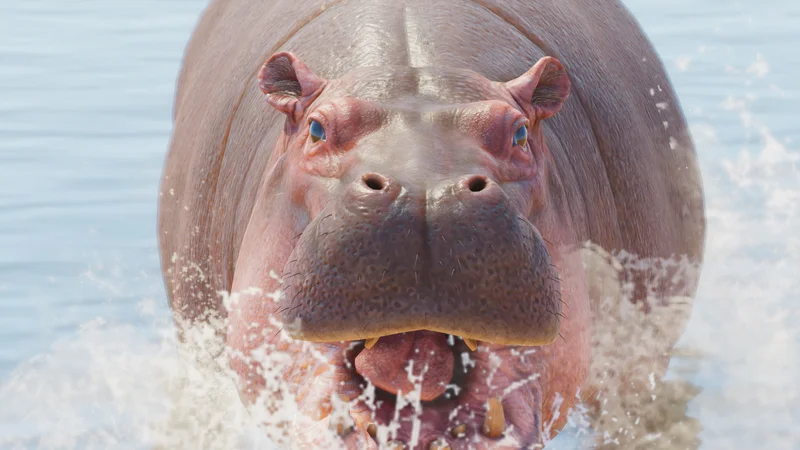
The Zoopedia lists the common hippopotamus as Vulnerable, pressured by grazing-land loss, retaliatory killing over crop damage, and the ivory trade in hippo teeth. It also records a strange modern footnote: Colombia’s feral population, descended from animals that escaped Pablo Escobar’s ranch, is booming — overgrazing wetlands, polluting waterways and out-competing native fauna. In-game, the animal carries the same duality. The famous 150-degree “yawn” is an aggression display, canines reach 50 cm, and a Grade 4 barrier exists for a reason.
Your education boards practically write themselves. The Zoopedia fact sheet notes that hippo skin is six centimetres thick and secretes a red natural sunscreen, that the animals travel up to five kilometres a night to graze on land, and that their closest living relatives are whales and dolphins. Guests remember the Planet Zoo 2 hippo as a cartoon; a well-placed fact sheet is how it becomes a conservation story.
Where the hippo sits in your progression
Hold the hippo until your savanna zone is profitable. At $728 a cycle plus a genuinely large dual-zone habitat, it is a commitment — but the payoff is real. Hippos appear on both the Great Rift Valley and Tanzania reserve rosters, the leucistic colour morph gives long-term breeders a rare chase, and the exhibit itself becomes your zoo’s water-design centrepiece. Release credit values for the Planet Zoo 2 hippo are still under community testing; see the wildlife reserves guide for how the release pipeline works, and all animals for where the hippo sits in the full roster.
Related Articles
animals
Planet Zoo 2 Giant Panda: Conservation, Breeding and FEN Economics
Planet Zoo 2 giant panda guide: official Zoopedia stats, why this Vulnerable bear anchors the Fauna & Ecosystems Network conservation economy.
animals
Planet Zoo 2 Komodo Dragon: Enclosure, Feeding and Release Status
Planet Zoo 2 Komodo dragon guide: official Zoopedia stats, habitat design for the world’s largest lizard, and its role as a zoo showpiece.
animals
Planet Zoo 2 Lion: Pride Management and Great Rift Valley Releases
How to keep lions in Planet Zoo 2: pride sizes, male vs female roles, habitat needs, enrichment and Great Rift Valley releases for this Vulnerable big cat.
Was this helpful?
Thanks for the feedback!