Planet Zoo 2 Giraffe: Height, High Feeders and a Silent Decline
Planet Zoo 2 giraffe guide: Masai vs Reticulated differences, high feeders, barrier quirks and why the tallest land animal is quietly vanishing.
Quick answer: In Planet Zoo 2 the giraffe question usually means the Masai giraffe (Giraffa tippelskirchi), the tallest animal in the game at up to 5.8 m. Official Zoopedia minimums ask for 1,500 m² of land, a 25 m² shelter, groups of 3–12, and feeding built around the suspended high grazer feeder. Two giraffe species ship at launch — Masai and Reticulated — and the Masai is Endangered, having lost more than half its wild population in thirty years. It is also the best mixed-species anchor on the savannah, with thirteen thriving companions.
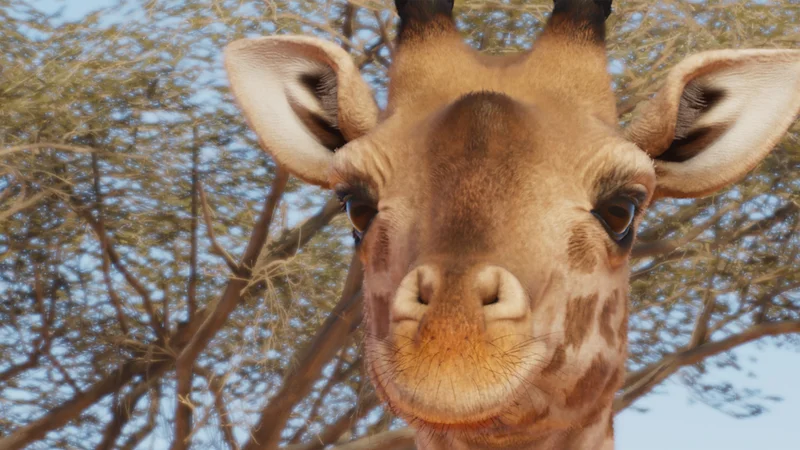
Two Giraffes, One Game: Know Which One You Are Keeping
Frontier shipped two giraffe species at launch, and the difference is more than a coat pattern. The Masai giraffe wears jagged, irregular, leaf-shaped blotches in dark brown to red, divided by pale yellow lines; its Reticulated cousin wears crisp, net-like polygonal patches. The Masai is a grassland animal of Kenya, Tanzania and Uganda, while the Reticulated giraffe ranges further north in the Horn of Africa. If your goal is a Serengeti-style exhibit, the Masai is the authentic pick — it is, after all, the national animal of Tanzania.
The Zoopedia lists the Masai giraffe at an average 5.4 m for bulls (up to 5.8 m, roughly 1,200–1,300 kg) and 4.7 m for cows at 800 kg. Its 45 cm prehensile tongue, seven neck vertebrae and thorn-proof lips are all confirmed in the official animal facts. One piece of trivia worth building an education sign around: in August 2025 the IUCN’s Giraffe and Okapi Specialist Group officially recognised four separate giraffe species, elevating the Masai from subspecies to full species — a reclassification driven almost entirely by conservation urgency.
Designing for Height: Fences, Shelters and the Feeding Vertical
Giraffe husbandry in Planet Zoo 2 is a vertical design problem. The official enrichment list is short and pointed: hanging barrel feeders, melon feeders, and the suspended high grazer feeder as food items, plus the gyro, large ball, rubbing pillar and skittle for habitat. Every food device either hangs or elevates, because a giraffe that eats off the ground is a giraffe behaving unnaturally. Cluster your feeders at head height along guest sightlines and the iconic “giraffe silhouette against the sky” shot takes care of itself.
The barrier numbers have already become one of launch week’s talking points. The Zoopedia specifies a modest Grade 2 barrier at just 1.25 m high — far below what any real zoo would use — which has players testing whether that genuinely contains a spooked animal or whether the numbers will be patched. Until Frontier comments, treat it as official-but-unproven; specific containment behaviour is still under community testing, and the prudent build is to use taller fencing than the minimum for aesthetics alone.
Space, by contrast, is not negotiable: 1,500 m² of land is the largest minimum on the savannah roster, with 20–90% grass tolerance and a temperature band of 12°C to 36°C. Feed costs run $939 per period — noticeably cheaper than the African savannah elephant, which is neutral rather than thriving company despite sharing the plains. For laying the exhibit out, our habitat design guide covers how to stack elevation so both giraffes and shorter guests see what they need to see.
Fission-Fusion: What Herd Management Actually Means Here
Do not copy lion or elephant social logic onto giraffes. The Zoopedia describes Masai giraffe society as fission-fusion: fluid groups whose composition changes constantly, organised loosely by age, sex and kinship rather than rigid hierarchy. Females and calves form loose associations, males drift between temporary bachelor groups and solitary life, and female dominance is based on age with a preference for older males.
Gameplay-wise this is forgiving — there is no pride politics or musth to engineer around — but it has one real implication: the Zoopedia asks for 3–12 animals and no strong pair bonds, so a rotating cast of giraffes works better than a fixed “family.” Reproduction mirrors that ease. Gestation runs 13–15 months, after which the cow separates from the herd and the calf drops 1.5 m to the ground, standing within the hour. The calf hides in bushes for about three weeks before rejoining the group, solid food starts at one month, and young males leave for bachelor life at three years. New players working through the beginner guide will find giraffes a low-drama first large herbivore — the challenge is space, not temperament.
The Savannah’s Best Roommate
Where the giraffe truly earns its keep is mixed-species stocking. The Zoopedia lists thirteen thriving relationships: nyala, sable antelope, springbok, Cape buffalo, Thomson’s gazelle, gemsbok, common ostrich, white-backed vulture, common warthog, black wildebeest, blue wildebeest and plains zebra, alongside its Reticulated cousin. That is the deepest compatibility list of any launch animal, and it effectively hands you a buildable Serengeti. A giraffe-plus-zebra-plus-ostrich flat reads as a complete ecosystem rather than a collection of cages, and it fills a 1,500 m² habitat with motion at every sightline. Browse the all-animals list to sketch combinations before you break ground.
The Quietest Extinction on the Roster
Here is the part that surprises most players: the giraffe is not fine. The Masai giraffe is listed as Endangered, with wild numbers around 32,000 and a decline of more than half over three decades — habitat loss, agricultural expansion, bushmeat poaching and human-wildlife conflict, compounded by weak enforcement in parts of its range. Giraffes as a whole have suffered what conservationists call a silent extinction: a charismatic, unmistakable animal declining in plain sight while public attention went elsewhere.
Planet Zoo 2 leans into that story deliberately. The Masai giraffe’s conservation topics include habitat loss, ecotourism and human-wildlife conflict, and the Zoopedia closes on a hopeful note — GPS tracking, improved monitoring and reintroductions into protected areas are working in pockets of Kenya and Tanzania. Your in-game herd is a small ambassador for that effort, and an albino-free but beautiful animal: its launch colourmorph roster is modest compared to the big cats. Give it a big sky, a high feeder and an honest education sign. The tallest animal on Earth deserves the tallest story in your zoo.
Related Articles
animals
Planet Zoo 2 African Elephant: Space, Matriarchs and Conservation
The complete Planet Zoo 2 African elephant guide: herd space, matriarch social needs, mud wallows, barrier grades and why this Endangered giant is worth it.
animals
Planet Zoo 2 African Wild Dog: Pack AI and Social Needs Guide
Planet Zoo 2 African wild dog guide: pack hunting behaviour, social group management, and how to release painted wolves to the Great Rift Valley reserve.
animals
Planet Zoo 2 Animals: Complete List of All 130 Species
Every Planet Zoo 2 animal at launch: all 130 species grouped by class with real-world conservation status, plus the new aquatics and flying birds explained.
Was this helpful?
Thanks for the feedback!