Planet Zoo 2 Gorilla: Silverback Family and Enrichment Guide
Planet Zoo 2 gorilla guide: official Zoopedia stats, Critically Endangered status, silverback group management, tool-based enrichment and slow breeding.
Quick answer: The western lowland gorilla is the most endangered animal in the Planet Zoo 2 launch roster — Critically Endangered, with an estimated 230,000–260,000 left in the wild according to the Zoopedia — and its mechanics carry that weight. You are managing one silverback-led family of three to six individuals in a 1,160 m² habitat with 40 m² of climbable structure, behind a Grade 3 barrier 3 m high, against an interbirth interval of 60 months. This is the deepest husbandry project in the game, built for keepers who want to run a family, not fill an exhibit.
A Critically Endangered flagship in your zoo
Every Zoopedia entry in Planet Zoo 2 ties its species to real conservation work, but the gorilla’s entry hits hardest. The species is listed as Critically Endangered, its Central African forests fragmented by logging, mining and agricultural expansion, with poaching so severe that entire troops are killed to capture a single infant for the illegal wildlife trade. Ebola has wiped out up to 90% of some local populations in recent decades. The entry offsets that with real counterweight: protected areas with anti-poaching patrols, community-based conservation programmes, and the zoo breeding networks the game’s Career mode models through the Fauna & Ecosystems Network.
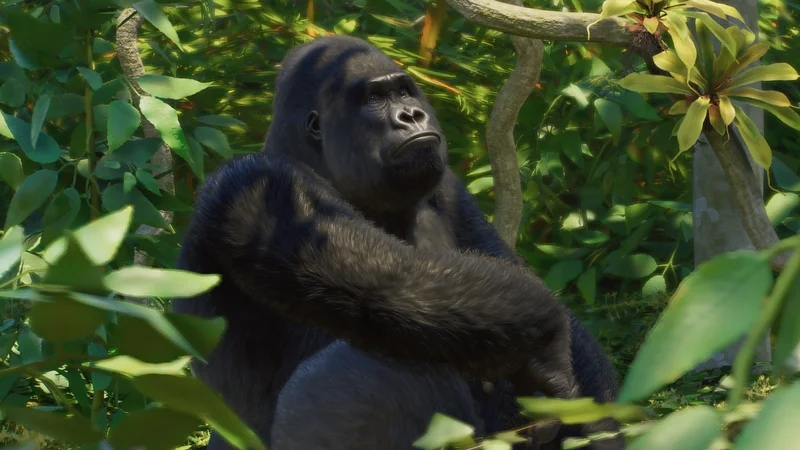
The animal itself sells the gravity. Males run to twice the size of females — a silverback averages 181.5 kg against a female’s 79 kg — and the grey saddle that earns him his name arrives with maturity. A Planet Zoo 2 gorilla habitat is the rare exhibit where guests instinctively lower their voices; design the viewing area to reward that instinct rather than fight it.
Official Zoopedia data
| Fact | Detail |
|---|---|
| Scientific name | Gorilla gorilla gorilla |
| Conservation status | Critically Endangered (IUCN) |
| Class / Order / Family | Mammalia / Primates / Hominidae |
| Native range | Rainforests of Central Africa |
| Temperament | Neutral |
| Planned population | 3–6 (one male maximum) |
| Barrier | Grade 3, 3 m high |
| Land / shelter / climbable | 1,160 m² / 15 m² / 40 m² |
| Food expense | $1,328 per cycle |
Note the height of that barrier — three metres, because these animals climb even though they mostly live on the ground. The terrain band wants 20–100% short grass with 10–80% soil and up to 40% rock, inside an 18–33 °C temperature window. The only cohabitation the Zoopedia permits is a neutral relationship with the western chimpanzee; everything else gets its own exhibit.
Life under the silverback: running the family group
The Zoopedia describes a group with one dominant male — occasionally two, a father and son — and females with remarkably strong bonds to each other and to their silverback, never leaving him for another male once the group is established. That loyalty is your management tool and your constraint. Keep exactly one breeding male; watch the calendar as sons approach maturity, because all offspring disperse between nine and ten years old, males wandering solitary until they can form their own groups. Courtship has its own choreography: an interested female approaches the silverback, holds eye contact, puckers her lips, and pounds the ground near him if he ignores her. Groups this small forgive nothing — one bad pairing decision echoes for in-game decades.
Enrichment for a mind that builds tools
Read the Planet Zoo 2 gorilla enrichment list and you are looking at a puzzle shelf, not a toy box: block of frozen fruit, forage box, fruit spike tree, fixed roller feeder, melon feeder, a genuine tool puzzle feeder, plus bobbin drum, mirror mobile, musical keyboard, rubber duck and tire. The mirror mobile and musical keyboard are not jokes — gorilla cognition research uses exactly such stimuli, and the Zoopedia’s animal facts justify the variety. Wild gorillas modify branches to reach food and to measure water depth; they build fresh nests every night, usually in trees; and Koko, born at San Francisco Zoo, learned over 1,100 signs.
Rotation is the whole game here. An animal this intelligent decodes a static habitat quickly, and boredom in a big brain shows up as welfare decay long before it shows up anywhere else. Our habitat design guide covers how to space enrichment across terrain so the group works for its dinner the way wild gorillas work a forest.
The 60-month waiting game
Reproduction is rated Easy, which is technically true and deeply misleading. Gestation runs about 8.5–9 months to a single infant, and the interbirth period is 60 months — five full years between births per female, with sterility at 44 and sexual maturity around 8–9. A mother carries her infant closely for its first four years, and juveniles of both sexes leave the group at nine to ten. Do the arithmetic and a female gorilla offers roughly five offspring across a whole in-game career. With an adult phase of 34 years and a further 16 of elderly life, a well-kept silverback anchors your zoo for half a century of in-game time. There is no churn to exploit and no morph lottery to spam — the Zoopedia lists only an albino morph — only decades of consistent welfare, careful pairing and patience. Exact breeding-timing and release-reward figures are still under community testing, and we will update this page as the community verifies them.
Choosing between the great apes
The launch roster includes other great apes, and the gorilla occupies a distinct niche among them. It is the largest primate on Earth, predominantly terrestrial, organised around a stable silverback hierarchy rather than the fluid fission-fusion politics of chimpanzees or the solitary arboreal life of orangutans — our pages on those species are on the way. If your zoo’s theme is rainforest conservation, the Planet Zoo 2 gorilla is the anchor animal: maximum gravitas, maximum commitment. Before committing, read the wildlife reserves guide to understand how release programmes work, and check all animals in Planet Zoo 2 to plan where this family fits your long-term roster.
Related Articles
animals
Planet Zoo 2 Hippo: Semi-Aquatic Habitat Design Guide
Planet Zoo 2 hippo guide: official Zoopedia stats, semi-aquatic habitat design, land-water ratios, territorial behaviour and Vulnerable conservation status.
animals
Planet Zoo 2 Giant Panda: Conservation, Breeding and FEN Economics
Planet Zoo 2 giant panda guide: official Zoopedia stats, why this Vulnerable bear anchors the Fauna & Ecosystems Network conservation economy.
animals
Planet Zoo 2 Lion: Pride Management and Great Rift Valley Releases
How to keep lions in Planet Zoo 2: pride sizes, male vs female roles, habitat needs, enrichment and Great Rift Valley releases for this Vulnerable big cat.
Was this helpful?
Thanks for the feedback!