Planet Zoo 2 Meerkat: Sentry AI, Burrows and Viewing Design Guide
Planet Zoo 2 meerkat guide: the colony AI and burrowing behind the cutest face in the game, plus sentinel behaviour, pack welfare and guest viewing design.
Quick answer: The meerkat looks like Planet Zoo 2’s designated crowd-pleaser, but its real value is systems depth: rotating sentry duty, cooperative burrow networks and predator-alarm group behaviour make it the best small-animal AI showcase in the game. The Zoopedia lists it as Least Concern — the wild population is not even quantified — which makes it a low-stakes, high-observation species perfect for learning group mechanics. Build it a sandy, diggable habitat with elevated lookout points and the colony will run itself in front of your guests.
Colony AI: the sentinel system
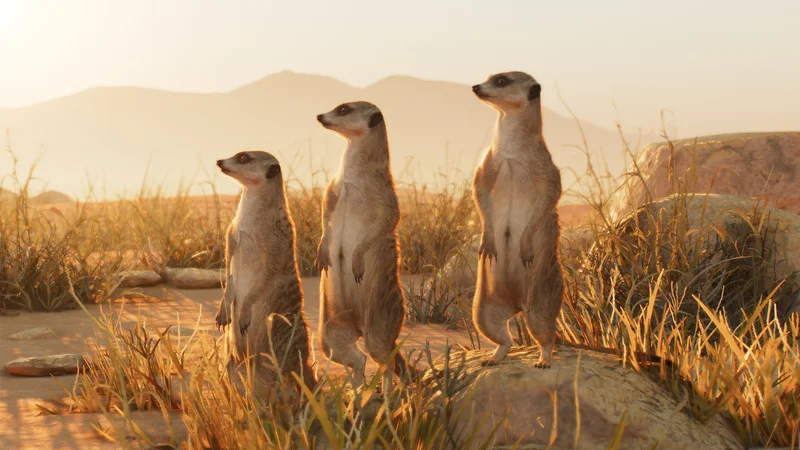
Meerkats survive the Kalahari by never relaxing, and Frontier built that vigilance into the species. The Zoopedia’s fifth animal fact is the design thesis: meerkat packs post sentries that give different alarm calls for different predators. In the game that becomes visible behaviour — an animal climbs onto a rock or mound, stands on its hind legs in the species’ signature pose, and holds station while the rest of the colony forages. When the sentinel reacts, the group responds as a unit, bolting for the burrow.
This is the game’s best argument that small animals are not filler. A meerkat habitat generates emergent micro-stories — foraging sweeps, babysitting clusters near the burrow mouth, sentinel rotation — without any scripting on your part. Spend ten minutes watching a mature colony and you will see the system cycle: a forager approaches the burrow mouth, a babysitter shifts position, the sentinel changes guard. None of it is decoration — it is the species’ welfare state rendered as behaviour, which is why the meerkat doubles as a diagnostic tool: a colony that stops posting sentries is telling you something is wrong. If you want guests to stand and watch an exhibit instead of walking past, colony behaviour is the hook. The habitat design guide covers the welfare systems underneath it; meerkats are the species where those systems are easiest to see working.
Burrows and digging mechanics
The Zoopedia describes meerkats as a social mongoose living in complex underground burrow systems across southern Africa’s savannahs and semi-deserts — real warrens that can sprawl to 15 entrances across multiple tunnel levels. Planet Zoo 2 translates that into the burrow feature: the colony digs, maintains and shelters inside excavated networks, and the game’s burrow camera lets you pipe underground footage to a viewing screen so guests can watch what happens below the sand.
Two practical notes for builders. First, digging is animation, not escape risk — Frontier has confirmed meerkats will not dig out of habitats, so you can use low, naturalistic barriers and custom fence work without burying your perimeter, a freedom the community has celebrated since the feature was announced. Second, the burrow needs open sandy ground to live in; burying the habitat under rockwork and hardscaping starves the behaviour. Give the colony a diggable substrate and let the terrain show it.
Viewing design: a top-down exhibit
Most great zoo exhibits are designed at eye level. The meerkat inverts that, and understanding the inversion is the design opportunity. The animals’ natural posture puts the interesting action above ground level — sentries on mounds, foragers crisscrossing open sand — and the burrow mouth is the colony’s front door. That makes the meerkat habitat a top-down exhibit: raise your guests on a low platform or berm, run a glass-fronted moat along the habitat edge, and the whole colony plays out in plan view like a living diorama.
It is the cheapest high-yield exhibit in Planet Zoo 2. A modest sandy bowl, a scatter of rocks at graduated heights, a dead-tree lookout, burrow screen and shade structure will outperform habitats ten times its size for dwell time — guests stay because there is always one more animal doing one more thing. Pair it with signage explaining the sentinel system and the exhibit quietly becomes the best-behaved teaching space in the park. For the broader toolkit of viewing structures and sightline tricks, our scenery themes page covers what builds pair well with African savannah palettes.
Pack welfare and the Least Concern advantage
The Zoopedia’s social facts are management instructions: meerkat females run a strict hierarchy where the oldest and largest female typically leads, packs mob snakes that enter their territory, and the species lives in groups from a handful to dozens of animals. In game terms, keep the colony together but watch the hierarchy — overcrowded colonies in undersized habitats are where welfare quietly degrades. Adults weigh under a kilogram, so the entire species fits in habitat footprints that would not hold one tiger. And because the species is small and cheap to house, it is tempting to overstock; resist it. The hierarchy fact exists in the Zoopedia for a reason — density stress in a one-kilogram mongoose shows up fast, and the fix is always more space and more burrow mouths, not more enrichment toys.
Then there is the conservation angle, and it is a refreshing inversion. The meerkat is Least Concern — the Zoopedia lists the wild population as unknown and the threats as indirect: habitat degradation from agriculture and mining, climate pressure on arid ecosystems, disease spillover from domestic animals. In a game where most headline species are Endangered, the meerkat is the species you keep because the behaviour is superb, not because the status is desperate. It is also the gentlest possible introduction to Planet Zoo 2’s group-management systems before you take on harder social species — see the full roster on the animal list.
The meerkat is where Planet Zoo 2’s group AI stops being a stat sheet and becomes a show. Small, cheap, Least Concern and endlessly watchable, it deserves a front-of-zoo plot with a raised viewing deck — and once the colony runs itself, take what you learned to the Sumatra reserve’s social species.
Related Articles
animals
Planet Zoo 2 African Elephant: Space, Matriarchs and Conservation
The complete Planet Zoo 2 African elephant guide: herd space, matriarch social needs, mud wallows, barrier grades and why this Endangered giant is worth it.
animals
Planet Zoo 2 African Wild Dog: Pack AI and Social Needs Guide
Planet Zoo 2 African wild dog guide: pack hunting behaviour, social group management, and how to release painted wolves to the Great Rift Valley reserve.
animals
Planet Zoo 2 Animals: Complete List of All 130 Species
Every Planet Zoo 2 animal at launch: all 130 species grouped by class with real-world conservation status, plus the new aquatics and flying birds explained.
Was this helpful?
Thanks for the feedback!