Planet Zoo 2 Plains Zebra: Starter Herd Animal Guide
Planet Zoo 2 zebra guide: official Zoopedia stats, starter herd economics, breeding tips, habitat minimums and Great Rift Valley release value.
Quick answer: The plains zebra is the most forgiving first herd animal in Planet Zoo 2: it costs $174 per food cycle, breeds at Easy difficulty, lives comfortably in a 460 m² habitat behind a Grade 2 barrier, and thrives alongside up to thirteen savanna species. A single stallion with three to five mares will produce foals fast enough to teach you the full breeding loop — and those offspring release into the Great Rift Valley and Tanzania reserves.
Why the plains zebra is the ideal starter animal
The opening hours of Career mode punish expensive mistakes, and the Zoopedia numbers explain why experienced players reach for the zebra first. Its periodic food expense is $174 — compare that with $728 for a common hippopotamus or $1,328 for a western lowland gorilla — and its reproduction difficulty is rated Easy, with a 13-month gestation, an 11-month interbirth period and sexual maturity at four years. No other herd animal in Planet Zoo 2 turns cash into baby animals, and baby animals into conservation credits, this quickly.
That pace matters because the early game is a lesson loop. You will make mistakes with terrain ratios, barrier strength and group composition; the Planet Zoo 2 zebra forgives all of them. Our beginner guide covers the systems these herds teach you, and the Career mode walkthrough explains why the Fauna & Ecosystems Network frames everything you do with them.
The numbers tell only half the story. Temperament is rated Confident, so the herd holds its ground near guests and viewing glass instead of bolting to the far fence — free entertainment value for a habitat that costs almost nothing to run. In franchise terms the Planet Zoo 2 zebra is compound interest: unremarkable in isolation, quietly funding everything else by your fifth in-game year.
Plains zebra at a glance (official Zoopedia)
| Fact | Detail |
|---|---|
| Scientific name | Equus quagga |
| Conservation status | Near Threatened (IUCN) |
| Class / Order / Family | Mammalia / Perissodactyla / Equidae |
| Native range | Eastern and Southern Africa |
| Temperament | Confident |
| Planned population | 3–6 (one male maximum) |
| Barrier | Grade 2, 1.25 m high |
| Food expense | $174 per cycle |
Herd economics: harems, stallions and turnover
The Zoopedia lifecycle text describes a harem structure that mirrors the wild: one dominant stallion, several females ranked by how long they have been with him, and young males that disperse into bachelor herds once they mature. Keep exactly one adult male in the habitat — the game caps the group at one male and five females, so a “1+5” herd of six is both the ceiling and the sweet spot.
Foals arrive roughly a year apart per mare, and each birth is an event guests actually stop for. Because reproduction difficulty is Easy and sterility only arrives at death, a founding trio can realistically become a self-sustaining herd within a decade. Long term, the species carries four colour morphs — erythristic, amelanistic, part melanistic and pseudomelanistic — which gives dedicated breeders a cosmetic chase long after the economics stop mattering.
Habitat minimums and savanna mixing
Plan around 460 m² of land and 10 m² of shelter. The terrain band wants 40–80% grass with 10–60% soil, tolerates up to 20% sand and rock, and asks for 0–10% waterlogged ground; the 14–36 °C temperature band suits Great Rift Valley-style savanna maps without heating or cooling support. Our habitat design guide covers sightlines and shelter placement in depth.
The thriving list is where the zebra quietly becomes the backbone of an entire zone: nyala, sable antelope, springbok, Cape buffalo, Thomson’s gazelle, Masai and reticulated giraffe, gemsbok, common ostrich, white-backed vulture, common warthog and both wildebeest species all thrive alongside it. Building one large mixed savanna around a zebra herd is the single most space-efficient layout in the game, and it pairs naturally with a Masai giraffe tower as the visual anchor.
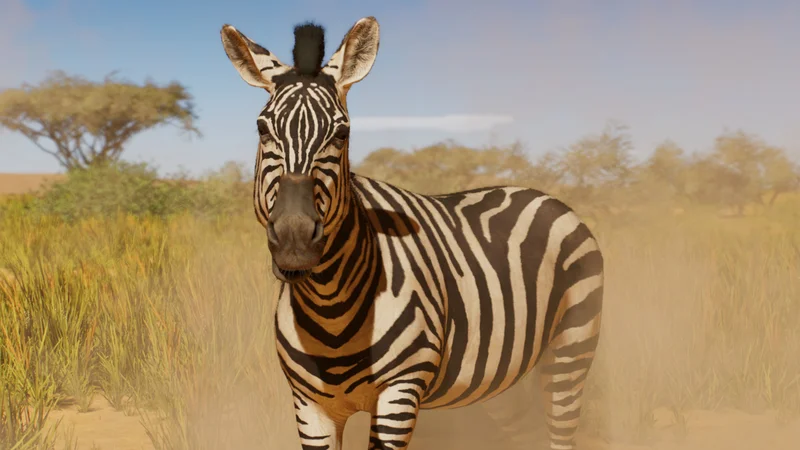
Keepers need gate access to both the shelter and the far end of the enclosure. Herds bunch at fences when spooked, and a keeper crossing the habitat at the wrong moment triggers exactly the welfare dip you are trying to avoid — route staff paths around the perimeter and let the animals come to you.
Every stripe is an individual
This is the detail that turns a starter animal into a favourite. The Zoopedia notes that zebras recognise one another by stripe pattern, and the game’s texture work makes that believable — no two animals in your Planet Zoo 2 zebra herd look identical. Name them, follow them, and guests will too. The entry also records that one plains zebra subspecies, the quagga, was hunted to extinction in 1878, and that wild herds migrate up to 1,600 kilometres to stay near rain and fresh grazing. The stripes themselves may be camouflage, predator-confusing motion dazzle, parasite deterrent or social badge — the Zoopedia notes science is still debating it, and the fact sheet rewards players who read closely.
From starter herd to conservation releases
The zebra appears on both the Great Rift Valley and Tanzania reserve rosters, which means every healthy foal you raise is a future release candidate. Establish the herd early, let it fund the rest of your zoo through guest draw, and pipeline surplus offspring into the reserve system described in our wildlife reserves guide. Exact release credit values per animal are still under community testing, and we will update this page as verified figures emerge. It is hard to overstate how rare that combination is: a species this cheap, this prolific and this release-ready is the closest thing Planet Zoo 2 has to a tutorial that pays for itself. For the full launch roster, see all animals in Planet Zoo 2.
Related Articles
animals
Planet Zoo 2 African Leopard: The Most Adaptable Big Cat
Planet Zoo 2 African leopard guide: Zoopedia profile, tree-climbing habitat design for its caching instinct, and how it differs from lion and snow leopard.
animals
Planet Zoo 2 Grizzly Bear: Brown Bear Subspecies, Diet and Hibernation Guide
Planet Zoo 2 grizzly bear guide: brown bear subspecies, omnivore feeding and food enrichment, hibernation and denning, habitat sizes and conservation.
animals
Planet Zoo 2 Spotted Hyena: The Matriarch Clan Guide
Planet Zoo 2 spotted hyena guide: Zoopedia clan data, what the laugh means, matriarchal social design, Great Rift Valley releases and the lion rivalry.
Was this helpful?
Thanks for the feedback!