Planet Zoo 2 Red Panda: Climbing, Cold Climate and Solitary Care Guide
Planet Zoo 2 red panda guide: internet-famous climber, Zoopedia care profile, arboreal habitat build, solitary management and Endangered conservation story.
Quick answer: The red panda is Planet Zoo 2’s internet-famous climber: a solitary, arboreal bamboo-eater that needs a cold, vertical Himalayan-style habitat rather than a flat paddock. The official Zoopedia lists it as Endangered with roughly 10,000 animals left in the wild, and the in-game species leans hard on climbing mechanics — branches, platforms and elevation are welfare infrastructure, not decoration. Manage it as a lone animal that meets others only on breeding schedules, and it will still anchor one of your zoo’s most-watched exhibits.
The internet’s favourite animal, in game form
Few animals arrive with a built-in fandom, but the red panda — the “firefox” of browser-logo fame — is one of them, and Frontier clearly knows it. The Zoopedia opens with taxonomy that surprises first-time keepers: Ailurus fulgens is not a small bear and not a raccoon, but the sole living member of the family Ailuridae, more closely related to weasels and skunks than to the giant panda it shares a name and a diet with. It lives in the temperate woodlands of the Himalayas and parts of China, at elevations where bamboo grows under conifer and broadleaf canopy.
The animal’s numbers are compact: 50–64 cm of body, a 28–59 cm ringed tail, and 3–6 kg of cat-sized carnivore. That tail is not cosmetic — it is a balance aid for canopy life, and the game treats it that way.
| Fact | Detail (official Zoopedia) |
|---|---|
| Scientific name | Ailurus fulgens |
| Conservation status | Endangered |
| Wild population | ~10,000 |
| Class / Family | Mammalia / Ailuridae |
| Native range | Asia (Himalayas, China) |
| Habitat type | Temperate montane forest |
Climbing mechanics and cold-climate needs
This is where the red panda separates from every “cute small mammal” on the roster. The Zoopedia describes a dedicated climber with a modified wrist bone — a “sixth finger” — for gripping bamboo, and fur on the soles of its paws for grip and insulation. For keepers, that translates into genuine vertical gameplay: the red panda will use elevated branches, platforms and overpasses, and a habitat without climbing structure is a habitat failing its welfare.
Cold is the other axis. Himalayan montane forest means cool temperatures, shade and humidity rather than savannah sun. Our habitat design guide covers how Frontier ties temperature bands, terrain mix and shelter to welfare; for the red panda, read that as a forested hillside build with dense foliage overhead and climbing lanes through every tier. If your zoo sits on a hot map, budget for heavy shade over the resting platforms and check the temperature overlay often — a red panda baking in full sun is one of the more visible welfare failures in the game. Frontier has not published official figures for temperature bands or space minimums; specific figures are still under community testing.
The payoff is one of the game’s most animated exhibits. A well-built red panda habitat has the animal moving through three dimensions all day — descending head-first down a trunk, napping along a branch, commuting across an overpass above your guests’ heads. That last trick, routing the climbing lane over a visitor path, turns a single animal into a whole-zoo attraction, and it is the clearest example of Planet Zoo 2 treating vertical space as real habitat area rather than scenery.
Solitary care: not a miniature giant panda
The Zoopedia is explicit that red pandas are solitary and territorial; in nature, the sexes meet only to mate. The game models that, so resist the urge to run a permanent mixed group the way you might with social species. House separately, introduce for breeding windows, and separate again — the animal’s welfare depends on controlling those interactions. One more quirk worth knowing: the fur on the soles of its paws is an insulation trait that hints at how cold the species runs, so if your habitat thermometer sits at tropical levels, treat that as a design error, not a preference.
The comparison with the giant panda is instructive. They share a bamboo diet and a solitary temperament, but they are not close relatives — the “panda” name is a historical accident — and their builds diverge: the giant panda is a ground-heavy temperate bear with a huge land footprint, while the red panda is a light canopy specialist. Housing them in neighbouring exhibits is a lovely educational pairing for guests, but it is a thematic pairing, not a shared-habitat one.
Breeding, release and the Endangered story
Breeding red pandas in Planet Zoo 2 follows the species’ real rhythm: the Zoopedia notes that pregnant females build nests in rock crevices and hollow trees before giving birth, so a birthing den is essential infrastructure, not optional scenery. Cubs raised to release quality can join the game’s conservation systems through a wildlife reserve release group; exact group compositions and rewards are specific figures still under community testing, and our Wildlife Reserves guide tracks how the system works.
The conservation stakes are real. Endangered since 2015, with deforestation, bamboo die-off cycles, landslides and poaching compressing a wild population of around 10,000, the red panda depends on forest corridors and community monitoring programmes documented in the Zoopedia. Planet Zoo 2 makes that dependence legible: the same animal that charms your guests is, in the wild, a specialist squeezed ever higher up the mountain as its forest disappears. Every released in-game animal is a small vote for that work.
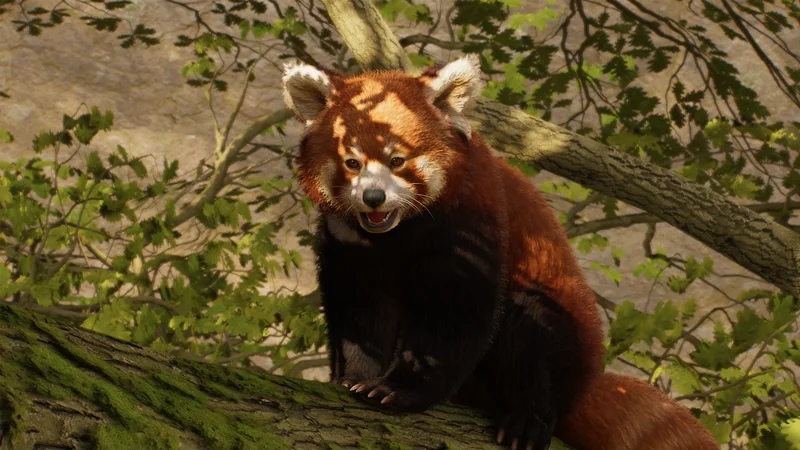
The red panda rewards keepers who build in three dimensions and manage solitude deliberately. It is one of the strongest demonstrations that Planet Zoo 2’s animal care is about matching real behaviour, not filling space — see how it contrasts with other species on the animal list.
Related Articles
animals
Planet Zoo 2 Sumatran Tiger: Sumatra Reserve Flagship Guide
Planet Zoo 2 Sumatran tiger guide: the game's only tiger, Zoopedia profile, jungle habitat build, wildlife reserve release and real conservation story.
animals
Planet Zoo 2 African Elephant: Space, Matriarchs and Conservation
The complete Planet Zoo 2 African elephant guide: herd space, matriarch social needs, mud wallows, barrier grades and why this Endangered giant is worth it.
animals
Planet Zoo 2 African Wild Dog: Pack AI and Social Needs Guide
Planet Zoo 2 African wild dog guide: pack hunting behaviour, social group management, and how to release painted wolves to the Great Rift Valley reserve.
Was this helpful?
Thanks for the feedback!