Planet Zoo 2 African Leopard: The Most Adaptable Big Cat
Planet Zoo 2 African leopard guide: Zoopedia profile, tree-climbing habitat design for its caching instinct, and how it differs from lion and snow leopard.
Quick answer: The African leopard is Planet Zoo 2’s versatility pick among the big cats. Where the lion anchors a social pride and the snow leopard demands a mountainside, the leopard — Panthera pardus pardus, listed as Vulnerable on the official Zoopedia — adapts to everything from savanna to riverine forest. Its defining gameplay hook is the caching instinct: leopards hoist kills into trees, which means your habitat needs climbable trunks more than it needs floor space. Build one good leopard exhibit and you have effectively learned the whole adaptable middle of the carnivore roster.
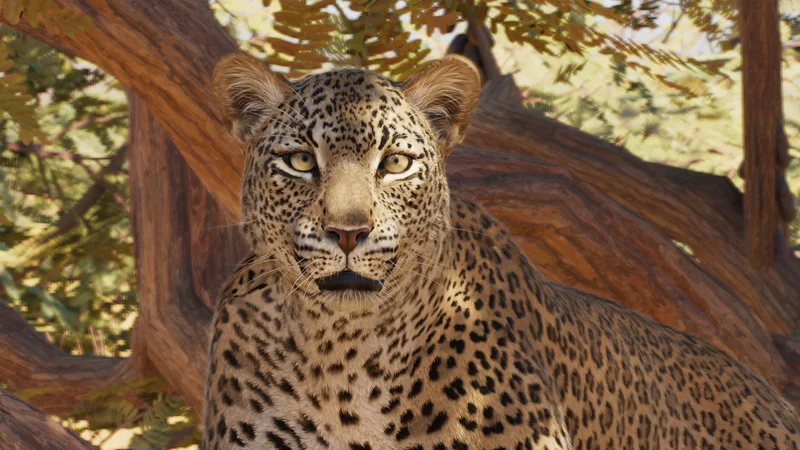
Not a reskin: where the leopard fits in the big-cat matrix
Planet Zoo 2 ships three Panthera cats, and it would be easy to read the African leopard as the middle entry — smaller than a lion, warmer-climate cousin of the snow leopard. That reading undersells it. The official Zoopedia describes the nominate leopard subspecies as the most widely distributed big cat on Earth, native across Central and Southern Africa and comfortable everywhere except true desert and rainforest interior. Adaptability is the species’ whole identity, and Frontier’s design reflects it: this is the big cat you can plausibly place in the broadest range of biomes without breaking believability.
The numbers underline a genuinely athletic animal. Males stand 60–70cm at the shoulder, measure 1.52–1.83m in head-body length plus a 66cm tail, and weigh 58–96kg; females are 55–65cm at the shoulder, 1.39–1.67m long with a 60cm tail, and a much lighter 24–37.5kg. The dimorphism is dramatic: males can reach two and a half times the female’s weight, the widest such gap among the game’s big cats. The coat runs yellow to dark golden with small, tightly spaced rosettes that dissolve into solid black spots on the lower body, face and tail tip, with white undersides — a pattern that reads beautifully against dry-grass theming.
The caching instinct: designing around a larder in the branches
Here is the behaviour that should drive your build. Leopards are classic caching predators: unable to defend a kill on the ground against lions or hyenas, they drag prey — sometimes heavier than themselves — up into a tree fork and feed on it over days. Planet Zoo 2 turns that natural history into the species’ signature habitat requirement. A leopard habitat without a climbable, forked tree is a habitat missing its centrepiece.
Design consequences follow. Place one or two reinforced, climbable trees near a shaded viewing area and position carcass-type feeders so the haul-up path crosses guest sightlines — a leopard dragging dinner skyward beats any scripted show. Our habitat design guide goes deeper on climbing structure placement, but the leopard’s rule of thumb is vertical redundancy: multiple ascent routes, multiple secure fork points, nothing that forces the cat to cross open ground to reach its larder. Solitary management is the Zoopedia’s social baseline — a mother with cubs is the only group you will run — so plan one animal per exhibit and spend the saved space on height instead.
Morphology field guide: leopard vs snow leopard
Because both pages launch on the same day, a direct comparison is worth spelling out — the two cats are evolutionary answers to opposite problems. The snow leopard is a cold-specialist: thick insulated fur rated to -25°C, a 0.8–1.05m tail for balancing on ridgelines, low sexual dimorphism, a shy temperament, and a Zoopedia terrain band that runs to 80% rock. The African leopard is the generalist: a shorter, everyday-length tail, a coat that shifts from golden to paler across arid populations, pronounced dimorphism, and a temperament built around bold adaptability rather than retreat.
The contrast is a gift for zoos with adjacent exhibits. Pair the two and you can theme an entire “one genus, two worlds” felid wing — Himalayan scree on one side of a back-of-house corridor, golden savanna on the other — telling guests that Panthera conquered both the roof of the world and the sun-baked floor beneath it. If you want the full roster context, the all-animals index tracks every species at a glance.
Great Rift Valley’s versatile ambush predator
Within the game’s Wildlife Reserves system, the African leopard is a Great Rift Valley resident — one of the reserve’s headline predators alongside lions, hyenas and wild dogs. Its adaptability maps neatly onto the release loop: a generalist predator slots into more ecosystem configurations than a specialist, making it a forgiving first release once your hoofed game is established. Frontier has not published official release requirements or rewards; specific figures are still under community testing, but the reserve page tracks the confirmed species list and programme structure.
In the franchise zoo, the leopard plays a subtler role: the predator that keeps working while your guest economy is young — one animal, one barrier, one excellent tree. For the five-need welfare system behind all of this, see our animal welfare guide.
Conservation story: the adaptable cat that still lost
The Zoopedia’s conservation section is blunt: despite the wide range, the African leopard is Vulnerable, and its wild population is genuinely unknown — a data gap that is itself the story. Agricultural and urban expansion, logging and fragmentation carve the range into islands; skins, claws and teeth feed both ritual demand and big-five trophy hunting; CITES Appendix I now prohibits international commercial trade in wild-caught animals.
The coda: wild cub survival is 40–50% in the first year, and accredited-zoo breeding programmes are part of the insurance policy. That is the loop the game asks you to run — breed, raise, release into the Rift Valley’s modelled ecosystem — and it lands harder once you know the real population is counted in guesses, not headcounts.
Quick FAQ
Is the African leopard different from the snow leopard in Planet Zoo 2? Yes — different species, different niches. The African leopard is a warm-climate generalist and caching climber; the snow leopard is a cold-specialist rock climber. Compare the two pages side by side.
Can leopards climb trees in Planet Zoo 2? Yes. Tree climbing and kill-caching define the species — build climbable, forked trees into the habitat rather than treating them as decoration.
Is the African leopard endangered? It is listed as Vulnerable on the IUCN Red List, with the wild population officially unknown. Habitat fragmentation and poaching are the leading threats.
How many leopards can live in one habitat? The Zoopedia describes a solitary species; the natural social unit is a mother with cubs. Exact in-game group limits are among the specific figures still under community testing.
Related Articles
animals
Planet Zoo 2 Grizzly Bear: Brown Bear Subspecies, Diet and Hibernation Guide
Planet Zoo 2 grizzly bear guide: brown bear subspecies, omnivore feeding and food enrichment, hibernation and denning, habitat sizes and conservation.
animals
Planet Zoo 2 Snow Leopard: Ghost of the Mountains Guide
Planet Zoo 2 snow leopard guide: official Zoopedia stats, alpine habitat design with rock climbing, and the Vulnerable conservation story of the ghost cat.
animals
Planet Zoo 2 Spotted Hyena: The Matriarch Clan Guide
Planet Zoo 2 spotted hyena guide: Zoopedia clan data, what the laugh means, matriarchal social design, Great Rift Valley releases and the lion rivalry.
Was this helpful?
Thanks for the feedback!