Planet Zoo 2 Snow Leopard: Ghost of the Mountains Guide
Planet Zoo 2 snow leopard guide: official Zoopedia stats, alpine habitat design with rock climbing, and the Vulnerable conservation story of the ghost cat.
Quick answer: The snow leopard is Planet Zoo 2’s dedicated high-mountain big cat — the animal you build cliffs for. Frontier’s official Zoopedia lists Panthera uncia as Vulnerable, native to the mountains of Central Asia, happiest between -25°C and 10°C, and demanding 705m² of land with 30–80% rock coverage. It is solitary, shy, compatible with no other species, and one of only two Panthera cats in the game that treats vertical terrain as home rather than enrichment. If your zoo has a rocky back wall, this is the species that turns it from scenery into habitat.
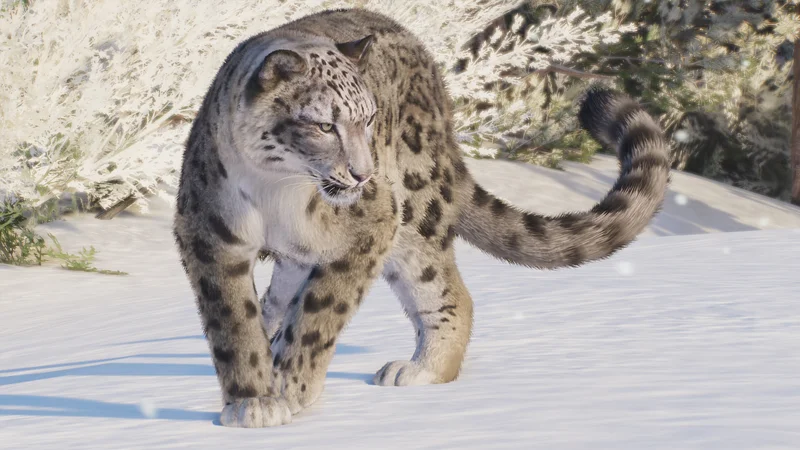
Why the “ghost of the mountains” is a different kind of big cat
Every big cat in Planet Zoo 2 answers a different design question. The lion asks whether you can manage a pride; the African leopard asks whether you can build for versatility. The snow leopard asks something no other species does: can you build upward? Locals across its range call it the ghost of the mountains, and the Zoopedia shows Frontier took the nickname literally — this is a cat whose entire body plan, from the 0.8–1.05m tail used as a counterbalance on ridgelines to the thick fur rated for -25°C, assumes altitude.
The Zoopedia places the species in Nepal, Tibet, northern India, southern Siberia, Pakistan, Bhutan and Mongolia, feeding mostly on mountain goats and sheep with birds and rodents filling the gaps. It is also one of the least sexually dimorphic big cats: males average 45–55kg against 35–40kg for females, so do not expect the dramatic size gap you see in lions. Its temperament is listed as Shy, and that single word should shape your whole exhibit — this is a cat that rewards guests who linger, not guests who expect a lap-pacing show.
Zoopedia profile: a cat engineered for altitude
The statistics block reads like a specification sheet for a mountain habitat. Land area requirement is 705m² with only 10m² of shelter, because this animal does not want a den — it wants exposure. The terrain mix is the giveaway: rock at 30–80%, snow anywhere from 0–100%, grass and soil capped at 60%, and waterlogged ground discouraged entirely. A Grade 2 barrier of 3m is sufficient, a quiet acknowledgement that snow leopards prefer retreat over confrontation.
| Requirement | Official figure (Zoopedia) |
|---|---|
| Scientific name | Panthera uncia |
| Conservation status | Vulnerable |
| Native range | Central Asia |
| Biomes | Taiga, Tundra |
| Land / shelter | 705m² / 10m² |
| Terrain | Rock 30–80%, snow 0–100% |
| Habitat temperature | -25°C to 10°C |
| Group size | 1–2, mixed or single-sex |
| Compatible species | None |
Food-based enrichments lean into the hunting repertoire: the Piñata Pronghorn and Rotation Line Feeder simulate the chase across broken ground, while ice blocks and the Frozen Blood Pumpkin double as both enrichment and climate theming. For the wider welfare picture — how nutrition, social grouping, enrichment and habitat quality roll into a single score — see our animal welfare guide.
Building a habitat it can actually climb
Here is where the snow leopard separates itself from every other felid on the roster. The Zoopedia’s rock band runs to 80% — treat that as permission, not a ceiling. Stacked rock formations with walkable tops let the cat traverse the enclosure above guest eye level, and the long tail animation Frontier built for balance work makes those crossings worth a viewing gallery on their own. Our habitat design guide covers the game’s terrain tools in depth, but three snow-leopard-specific notes stand out.
First, gradient is habitat. A flat 705m² paddock technically meets the requirement and completely wastes the species; the same area tilted into a scree slope with ledges reads as Himalayan within seconds. Second, snow is optional in the percentages but powerful in the theming — the 0–100% band means a summer pelouse and a winter snowfield are both legal, so seasonal rebuilds are a design choice rather than a welfare risk. Third, respect the Shy temperament with visual barriers: sightline breaks behind rock fins give the cat somewhere to ghost away to, which paradoxically keeps it visible more often because a stressed animal parks itself behind cover.
The conservation story behind the rosettes
The wild arithmetic gives this exhibit its weight. The Zoopedia lists the snow leopard as Vulnerable; the figure conservation organisations converge on is roughly 4,000–6,500 mature individuals spread across twelve range states — a population smaller than the guest count of a busy in-game Saturday. The threats are the standard alpine litany with a cruel twist: retaliatory killing after livestock losses, poaching for fur and bones, a warming climate pushing the treeline — and the snow leopard’s prey — ever higher into an shrinking cold zone.
That is why the species carries conservation topics in-game ranging from human-wildlife conflict to genetic bottlenecks, and it is the thread that ties this page to the game’s reserve system. The Scottish Highlands reserve is the closest thematic neighbour — the game’s only mountain reserve, built around the same cold-weather, low-density design language, with species like the grey wolf proving that northern rewilding programmes make compelling play even with small cohorts. The Highlands’ release list is strictly European, so a snow leopard release is not on the table; the link is aesthetic and philosophical. If Frontier ever adds an Asian highland reserve, this cat is the obvious flagship — check the full animals list to see how the roster is shaping up.
Quick FAQ
Is the snow leopard hard to keep in Planet Zoo 2? Moderately. Its welfare demands are not extreme — a Grade 2 barrier, no compatible-species complexity, a small group of one or two — but the terrain expectations are the highest of any felid. Budget real construction time for rockwork.
Can snow leopards climb in Planet Zoo 2? Yes. Climbing rocky terrain is core to the species’ identity, and the Zoopedia’s 30–80% rock requirement reflects it. Build ledges and scree slopes the cat can traverse.
How many snow leopards are left in the wild? Approximately 4,000–6,500 mature individuals across Central Asia, with the species listed as Vulnerable on the IUCN Red List.
Does the snow leopard go into a Wildlife Reserve? Not at launch — no Asian mountain reserve exists yet. The Scottish Highlands reserve is the thematic counterpart, but its release list is European-only.
What does the snow leopard eat in game? The Zoopedia classifies it as a carnivore feeding on mountain ungulates; exact diet quantities are among the specific figures still under community testing.
Related Articles
animals
Planet Zoo 2 African Leopard: The Most Adaptable Big Cat
Planet Zoo 2 African leopard guide: Zoopedia profile, tree-climbing habitat design for its caching instinct, and how it differs from lion and snow leopard.
animals
Planet Zoo 2 Lynx: Eurasian Lynx Habitat Design and Rewilding Guide
Planet Zoo 2 lynx guide: Eurasian lynx stealth hunting, vertical habitat design for a climbing cat, solitary care versus lions, and European rewilding.
animals
Planet Zoo 2 Wolf: Pack Hunting AI, Monogamous Pairs and Rewilding Guide
Planet Zoo 2 wolf guide to pack hunting AI, monogamous alpha pairs, Scottish Highlands rewilding, and the habitat, barrier and welfare needs of grey wolves.
Was this helpful?
Thanks for the feedback!