Planet Zoo 2 Lemur: Ring-Tailed Matriarchs, Walkthrough Exhibits and Troop Care
Planet Zoo 2 lemur guide: Zoopedia stats, Endangered status, matriarchal troops of up to thirty, walkthrough exhibits and seven-month breeding.
Quick answer: The ring-tailed lemur is Planet Zoo 2’s most accessible primate: an Endangered Madagascan species that lives in matriarchal troops of three to thirty, costs only $292 per feeding cycle, and is one of the few animals in the game that guests can walk through among. You need just 210 m² of land with 20 m² of climbable structure behind a Grade 2 barrier 3 m high, and the seven-month interbirth period makes troop growth genuinely fast. It is the easiest great first primate in the game.
Madagascar’s matriarchy in miniature
Every lemur on Earth comes from Madagascar, and the ring-tailed lemur is its most famous export. The animal behind the Lemur catta name is compact — 39–46 cm of body, a 56–63 cm tail tipped in black, about 2.2 kg — with a pointed muzzle, cat-like ears and the dental comb the Zoopedia highlights as a grooming speciality. But the trait that shapes your zookeeping is social: this is a matriarchy.
Females are interrelated and stay with their mother’s troop for life; the dominance structure runs matriarchal, with females controlling feeding and grooming access. Males migrate. Young males leave at three to five years old and change groups several times across a life, which the Zoopedia lists as male offspring dispersal. Mating is promiscuous and seasonal, running from mid-April to mid-May, with the alpha structure deciding who breeds — low-ranking males may not mate at all. Keep your female core stable and let the game rotate dispersing males naturally, and the troop takes care of its own politics.
Ring-tailed lemur by the numbers
| Fact | Detail |
|---|---|
| Scientific name | Lemur catta |
| Conservation status | Endangered (IUCN) |
| Wild population | ~2,000 |
| Class / Order / Family | Mammalia / Primates / Lemuridae |
| Temperament | Confident |
| Planned population | 3–30 (max 29 per sex) |
| Barrier | Grade 2, 3 m high |
| Land / shelter / climbable | 210 m² / 2 m² / 20 m² |
| Food expense | $292 per cycle |
Three numbers stand out against the great apes. The barrier drops to Grade 2 — these are 2.2 kg animals, not 90 kg apes. The short grass band is 10–40% rather than the apes’ 20–100%, nudging you toward a drier, scrubbier Madagascan spiny-forest look instead of lush lawn. And guests can walk through: true. This is an exhibit you build around a path, not a fence line. The only neutral relationship is the golden lion tamarin, so treat the lemur habitat as its own self-contained world.
Sunning, stink fights and troop theatre
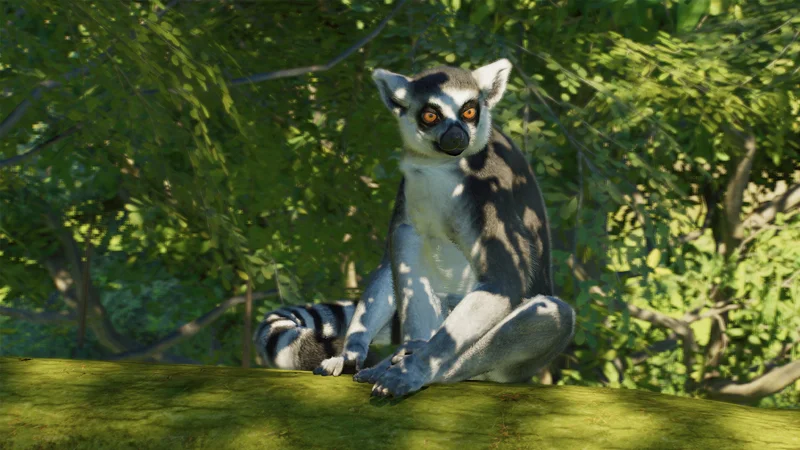
Ring-tailed lemurs are diurnal and behaviourally generous. Troops travel several kilometres a day foraging for leaves and fruit, and the animals are playful and friendly within their own group — the constant low-level social traffic of thirty confident primates is exactly what makes this species such a strong display animal. The famous posture is sunning: lemurs sit upright with arms spread and faces tilted to the morning sun, basking to warm a body that lost much of its ancestral thermoregulation toolkit. Stage flat basking rocks and open ground facing the sunrise side of the habitat and you will see it constantly.
Then there is the theatre. Males compete through stink fights — dragging their tails across scent glands on the wrists and shoulders, then waving the perfumed tail at rivals. Add the tail-up troop marching, the reflective retinas behind excellent night vision, and one management warning: troops are aggressive toward other lemur troops, so exactly one troop per habitat, however tempting a second group becomes once the babies arrive.
The walkthrough exhibit star
The guests-can-walk-through flag changes the design brief completely. Instead of a moat and railing, you are building a path with a low Grade 2 barrier, sightlines at lemur height, and basking stones within arm’s reach of visitor cameras. At 2.2 kg, the animals are harmless, confident around people, and photogenic from every angle — the tail alone outdraws most megafauna on social media. Keep the climbing structure (20 m²) over and beside the path so the troop passes overhead, and place the 2 m² shelter where shy animals can retreat from foot traffic.
Walkthrough design still has welfare stakes: visitors are a constant stimulus, and our animal welfare guide explains how to read stress signals in exposed species. The habitat design guide covers routing guest paths so animal and visitor circulations reinforce rather than collide — the same principle behind any good small-primate exhibit, including the red panda setup.
Cheap, fast and generous
Where the great apes are decades-long commitments, the lemur is a compounding asset. Gestation runs about 4.5 months to one or two infants, the interbirth period is just seven months, and sexual maturity arrives at three years — with sterility at 16 and life phases of 3 juvenile, 13 adult and 11 elderly years. A founding trio can realistically become a full, guest-delighting troop within a handful of in-game years, and at $292 per feeding cycle against the chimpanzee’s $1,221, scaling up costs almost nothing. The single listed morph is leucistic. Exact market and release values are still under community testing, but the economics already favour the lemur as an early-game income and appeal engine — see the all-animals page to slot it into a starter roster.
Endangered in the wild, thriving in human care
The conservation picture is sobering and oddly hopeful at once. The wild population stands at roughly 2,000 and falling — slash-and-burn agriculture, charcoal production and logging have fragmented Madagascar’s forests, while bushmeat hunting, the pet trade and severe droughts keep pressure on what remains. Yet the ring-tailed lemur breeds reliably in human care and is one of the most numerous lemurs in zoos worldwide, which is precisely why the species anchors Madagascar education programmes globally. In Planet Zoo 2, the attached education topics — habitat loss, deforestation, the exotic pet trade — turn a walkthrough exhibit into the park’s best conservation classroom. The troop that entertains your guests is also the argument for why its wild cousins deserve protection.
Related Articles
animals
Planet Zoo 2 African Elephant: Space, Matriarchs and Conservation
The complete Planet Zoo 2 African elephant guide: herd space, matriarch social needs, mud wallows, barrier grades and why this Endangered giant is worth it.
animals
Planet Zoo 2 Giraffe: Height, High Feeders and a Silent Decline
Planet Zoo 2 giraffe guide: Masai vs Reticulated differences, high feeders, barrier quirks and why the tallest land animal is quietly vanishing.
animals
Planet Zoo 2 African Leopard: The Most Adaptable Big Cat
Planet Zoo 2 African leopard guide: Zoopedia profile, tree-climbing habitat design for its caching instinct, and how it differs from lion and snow leopard.
Was this helpful?
Thanks for the feedback!