Planet Zoo 2 Spotted Hyena: The Matriarch Clan Guide
Planet Zoo 2 spotted hyena guide: Zoopedia clan data, what the laugh means, matriarchal social design, Great Rift Valley releases and the lion rivalry.
Quick answer: The spotted hyena is Planet Zoo 2’s sleeper star — a confident, Least Concern clan predator whose society runs on female power, not the cowardly scavenger caricature. The official Zoopedia lists Crocuta crocuta at 940m² of land, a Grade 3 barrier, groups of two to three, and a dominance structure described as matriarchal and nepotistic. Its famous laugh is a tension signal, not a giggle. Build it a den complex, keep the clan small, and it will out-entertain half the big cats in your zoo — while the lion habitat next door tells the other half of its story.
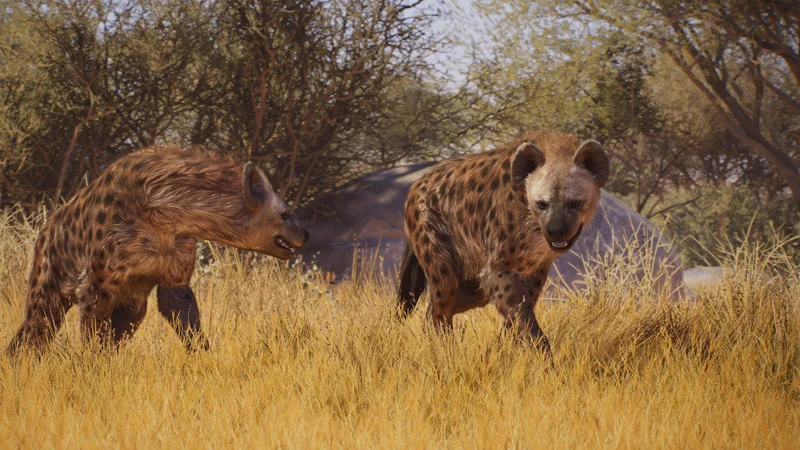
The misunderstood predator that runs on sisterhood
Start with the correction every good hyena exhibit exists to make. Spotted hyenas are not primarily scavengers — their powerful forelimbs and well-muscled necks are built for running prey down, and in much of Africa they are the ones lions steal from, not the reverse. They are also not led by males. The Zoopedia’s social statistics describe the clan as matriarchal and nepotistic: adult females outrank all immigrant males, daughters inherit their mother’s rank, and the dominant lineage eats first. Females are the larger sex — 44–64kg against 40–55kg for males — one of the few mammal species where that holds.
Adults stand 70–92cm at the shoulder under sandy fur with black spots and a mane running from neck to mid-back. The broad head and wide snout look odd beside the felids on the roster, but that skull houses the strongest jaws per body size among African carnivores — the hardware behind a predator that cracks bone the way other predators chew meat. This is the animal you build when you want guests to leave the zoo arguing about what they thought they knew.
Reading the laugh: a field guide to hyena voices
The “laughing hyena” label does the species a disservice, and the game’s audio design is a chance to fix it. In spotted hyena society, the stuttering whoop-giggle is a submissive signal — nervousness, excitement or social anxiety, often around dominant clan members or a contested carcass. It is the hyena equivalent of a nervous laugh in a tense meeting, a better info-board story than the cartoon cackle.
The wider vocal repertoire is equally interpretable. Whoops carry over kilometres and identify individuals; low growls police the queue at a kill; the call that rises at dusk is contact-calling, not comedy. Frontier lists the species among the game’s vocal-animal showcase topics, so expect the calls to trigger when clan tension rises — exactly when you should be watching the dominance interactions play out. Our animal welfare guide explains the social-needs system those interactions feed into.
Clan management in the zoo
Wild clans of up to ninety share a communal den for sleeping, mating and birthing — but the Zoopedia is explicit that the zoo should not replicate this. Spotted hyenas run a fission-fusion society: clan members sleep together but forage alone or in twos and threes, and cramming many of them into an enclosure produces violence. In captivity, the game wants compatible pairs and trios. Offspring dispersal is handled by the males — young males leave, young females stay — so plan for matrilines, not bachelor groups.
Habitat specifics from the statistics block: 940m² of land with a modest 10m² of shelter, a Grade 3 barrier at 3m (the confident temperament demands respect), and a terrain band of 20–80% grass with sand, rock and soil all welcome between 0–50%. The temperature window is wide, 14°C to 41°C — everything except true rainforest and desert. Enrichment skews playful and chewy: tug ropes, chew toys, prey-scented sacks and frozen blood pumpkins all map onto natural tug-of-war, bone-cracking and caching behaviour. One design note: a multi-entrance den lets a subordinate exit an encounter instead of escalating it — cheap insurance against the aggression the Zoopedia warns about.
Hyenas vs lions: the rivalry the game hands you
No two roster species are as historically intertwined. Lions and hyenas contest the same kills across the same savanna, and both steal from each other — the cliché of the hyena as thief obscures that prides routinely appropriate hyena kills. Build the lion and hyena habitats within sight of each other and guests will read the rivalry across the path; interpretive signage can run the honest version of the story.
The comparison flatters the hyena: the lion works through coalition and brute size, the hyena through clan coordination and endurance — clans have been recorded stripping a buffalo in under twenty minutes. In the game’s Great Rift Valley reserve, both are confirmed releasable predators — the reserve page tracks them alongside the African leopard and wild dogs — and sequencing their releases behind established hoofed game mirrors the trophic logic the reserve’s ecosystem models.
Why a Least Concern species still matters
The Zoopedia lists the spotted hyena as Least Concern, and it is tempting to file it beside the giraffes under “easy exhibits”. Two arguments against that. First, perception is a conservation problem: the scavenger caricature has dampened funding and sympathy, and modern programmes lean on re-education. A zoo game played by millions is precisely the venue to correct it. Second, the species is not uniformly secure — regional populations decline under persecution, poisoning and body-part demand tied to traditional medicine, all flagged in the game’s conservation topics.
So give the hyena the interpretive budget you would give a tiger. The all-animals index lists it as Least Concern; the exhibit’s job is to explain why that label undersells both the animal and the work that keeps it there.
Quick FAQ
Are hyenas predators or scavengers in Planet Zoo 2? Predators. The Zoopedia classifies them as generalist predators and scavengers, but they hunt most of what they eat — lions steal from them more often than the reverse.
Why is the female hyena bigger than the male? Females run 44–64kg against 40–55kg for males, and clan rank passes down the female line — the Zoopedia lists dominance as matriarchal and nepotistic.
What does the hyena laugh mean? It is a submissive or nervous signal, usually around dominant clan members or contested food — excitement and tension, not amusement.
Can spotted hyenas be released in the Great Rift Valley reserve? Yes — they are a confirmed Rift Valley species. Exact release requirements and rewards are among the specific figures still under community testing.
How many hyenas can live together in one habitat? The Zoopedia recommends compatible pairs and trios in captivity despite the huge wild clans, because confined aggression escalates. Max two adults per sex.
Related Articles
animals
Planet Zoo 2 African Leopard: The Most Adaptable Big Cat
Planet Zoo 2 African leopard guide: Zoopedia profile, tree-climbing habitat design for its caching instinct, and how it differs from lion and snow leopard.
animals
Planet Zoo 2 Grizzly Bear: Brown Bear Subspecies, Diet and Hibernation Guide
Planet Zoo 2 grizzly bear guide: brown bear subspecies, omnivore feeding and food enrichment, hibernation and denning, habitat sizes and conservation.
animals
Planet Zoo 2 African Wild Dog: Pack AI and Social Needs Guide
Planet Zoo 2 African wild dog guide: pack hunting behaviour, social group management, and how to release painted wolves to the Great Rift Valley reserve.
Was this helpful?
Thanks for the feedback!