Planet Zoo 2 Chimpanzee: Tool Use, Fission-Fusion Troops and Enrichment Guide
Planet Zoo 2 chimpanzee guide: Zoopedia stats, Critically Endangered status, fission-fusion troop management, tool enrichment and 52-month breeding.
Quick answer: The western chimpanzee is Planet Zoo 2’s most cognitively demanding primate — a Critically Endangered great ape that lives in fluid fission-fusion troops of five to fifteen, uses tools more than any other animal in the launch roster, and costs $1,221 per feeding cycle. Plan for a 780 m² habitat with 80 m² of climbable structure behind a Grade 3 barrier 3 m high, cap the group at ten individuals of either sex, and expect a 52-month gap between births. If the western lowland gorilla tests your patience, the chimpanzee tests your wits.
Tool use is the design brief
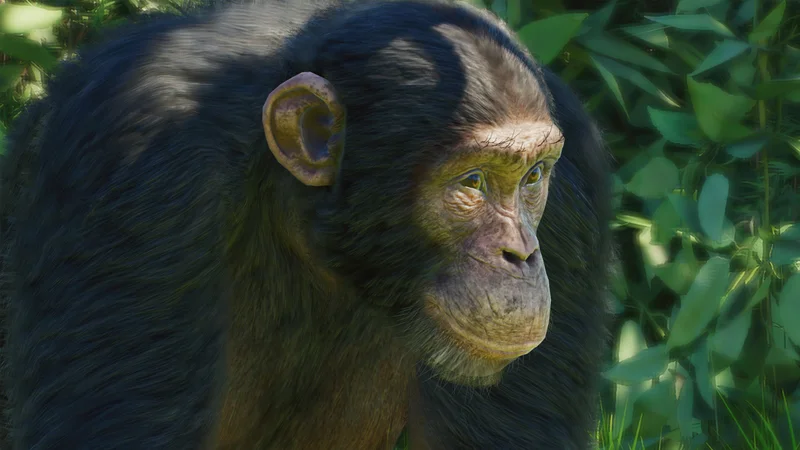
No animal in Planet Zoo 2 justifies its exhibit through behaviour the way the chimpanzee does. Wild western chimpanzees strip twigs to fish termites out of mounds, crack nuts against stone anvils, and — uniquely among chimpanzee subspecies — fashion spears to hunt sleeping primates. The Zoopedia’s animal facts pile on: sick chimps dose themselves with medicinal leaves, they collect fermented palm sap to drink, they have been observed keeping hyraxes as temporary pets, and Washoe, a wild-born female, learned 350 signs of human sign language and taught some to her son.
The game’s enrichment list reads like that field research translated into furniture: a termite mound and a natural termite mound, a tool puzzle feeder, forage box, fruit spike tree, melon feeder, block of frozen fruit, fixed roller feeder and a suspended forager. Your habitat is not a diorama — it is a workshop. Every object should invite manipulation, and the terrain bands (20–100% short grass, 10–80% soil, up to 20% sand and 40% rock, inside 18–33 °C) leave plenty of room to stage tool-use stations across the enclosure rather than clustering them at the glass.
The Zoopedia numbers
| Fact | Detail |
|---|---|
| Scientific name | Pan troglodytes verus |
| Conservation status | Critically Endangered subspecies (IUCN lists the common chimpanzee species as Endangered) |
| Wild population | 21,000–53,000 |
| Class / Order / Family | Mammalia / Primates / Hominidae |
| Temperament | Confident |
| Planned population | 5–15 (max 10 per sex) |
| Barrier | Grade 3, 3 m high |
| Land / shelter / climbable | 780 m² / 10 m² / 80 m² |
| Food expense | $1,221 per cycle |
Two details reward attention. The 80 m² of climbable area sits exactly double the gorilla’s 40 m² — chimps are far more arboreal than their ground-dwelling cousins. And the only neutral relationship the Zoopedia grants is with the western lowland gorilla, so a mixed great-ape savannah is at least technically on the table, though most keepers will give each species its own stage.
Managing a troop that reshuffles itself
The defining trait of chimpanzee society is that it has no fixed shape. Wild troops operate on a fission-fusion model: the community of five to fifteen exists as a stable unit, but it constantly splits into smaller foraging parties that rejoin hours or days later. Dominance is patriarchal, based on age and family relations, and the males of a group are interrelated for life. Females, by contrast, migrate out to an unrelated group at around ten years old — the Zoopedia lists female offspring as the dispersing sex.
The troop bonds through hunting and grooming, and skills pass socially from one individual to the next, including how to use sticks and rocks as tools. In practice this means a chimp habitat should never feel static to its residents. Multiple feeding stations, visual barriers and separate climbing routes let the game’s social simulation express those subgroup splits; a single open lawn with one feeding point forces every animal into constant proximity, which is exactly where welfare pressure starts to build. Our animal welfare guide covers the signals to watch for in confident, high-energy species like this.
Enrichment for animals that outthink static habitats
An intelligent animal decodes a predictable habitat quickly, and a bored chimpanzee is a welfare incident waiting in the grass. Rotate the food-based set — termite mounds, the tool puzzle feeder, frozen fruit blocks — on a schedule rather than filling every socket at once. The habitat enrichments (bobbin drum, mirror mobile, musical keyboard, curio ball, grab ball, stuffed panda) are not filler: mirror and sound stimuli map onto real primate-cognition research, and variety is the point.
Spaced placement matters as much as rotation. Wild chimps work for food across a home range, and scattering problem-solving stations across the 780 m² turns feeding into foraging. The habitat design guide goes deeper on spacing enrichment along natural movement routes so the whole troop stays engaged at once.
Chimpanzee, gorilla or orangutan?
Three great apes in the launch roster, three fundamentally different exhibits. The gorilla is a terrestrial family project: three to six individuals, one silverback, stable hierarchies, the deepest long-term commitment. The chimpanzee is a social puzzle: three times the headcount, shifting subgroups, and the game’s richest tool-use sandbox. The Sumatran orangutan is the opposite extreme — a largely solitary climber where the design challenge is vertical, not social. If you want a big, loud, busy primate hub with constant behavioural variety, choose the chimpanzee. If you want one unforgettable focal animal, choose the gorilla or orangutan. Budget-wise all three sit in the same bracket, so decide on temperament, not cash flow, and check the full roster on the all-animals page before committing habitat space.
The 52-month breeding game
Reproduction is rated Easy, which refers to the mechanics, not the calendar. Gestation runs eight months to a single infant, and the interbirth period is 52 months — over four years per female. Sexual maturity arrives at 14, sterility at 50, and the life phases split into 14 juvenile, 36 adult and 10 elderly years. Females disperse around age ten while males stay, so plan your founding group with female imports in mind. Two colour morphs exist — leucistic and a darker variation — but do not chase morphs at the cost of genetic diversity across a 50-year reproductive window. Exact pairing bonuses and release-programme rewards are still under community testing, and we will update this page as the community verifies them.
Related Articles
animals
Planet Zoo 2 Clown Anemonefish Guide: Anemone Symbiosis and Reef Tank Care
Planet Zoo 2 clownfish guide: pair them with a host sea anemone, keep 1 to 5 fish in 50 m² of saltwater at 24-28°C, and breed a dominant pair the easy way.
animals
Planet Zoo 2 Hammerhead Shark Guide: The Great Hammerhead's Sixth Sense
Planet Zoo 2 hammerhead shark guide: the Deluxe great hammerhead needs 960 m², Grade 3 barriers and a solitary life as a Critically Endangered giant.
animals
Planet Zoo 2 Leopard Shark Guide: Deep Dives and Nocturnal Life
Planet Zoo 2 leopard shark guide: the zebra shark dives to 200 ft, rests by buccal pumping, lays huge eggs and needs just 36 m² and a Grade 2 barrier.
Was this helpful?
Thanks for the feedback!