Planet Zoo 2 Grizzly Bear: Brown Bear Subspecies, Diet and Hibernation Guide
Planet Zoo 2 grizzly bear guide: brown bear subspecies, omnivore feeding and food enrichment, hibernation and denning, habitat sizes and conservation.
Quick answer: The grizzly bear in Planet Zoo 2 is Ursus arctos horribilis, a North American subspecies of the brown bear, listed as Least Concern. It is a solitary, confident omnivore that wants 970 m² of land, a 30 m² shelter, 30 m² of aquatic space and a Grade 4 barrier at 2 m high. Its defining mechanics are an omnivore diet that rewards foraging-style enrichment, and delayed implantation that times cub births to the middle of hibernation.
Grizzly or brown bear? Untangling the names
The name confusion is biological, not just cosmetic. Wikipedia treats the grizzly as a population or subspecies of the brown bear (Ursus arctos) native to the northern USA and Canada, sitting on a continuum that also includes the Kodiak bear and other North American forms. The word itself likely comes from “grizzled” — grey-tipped hair — although the naturalist George Ord classified it as horribilis in 1815 for its fearsome reputation.
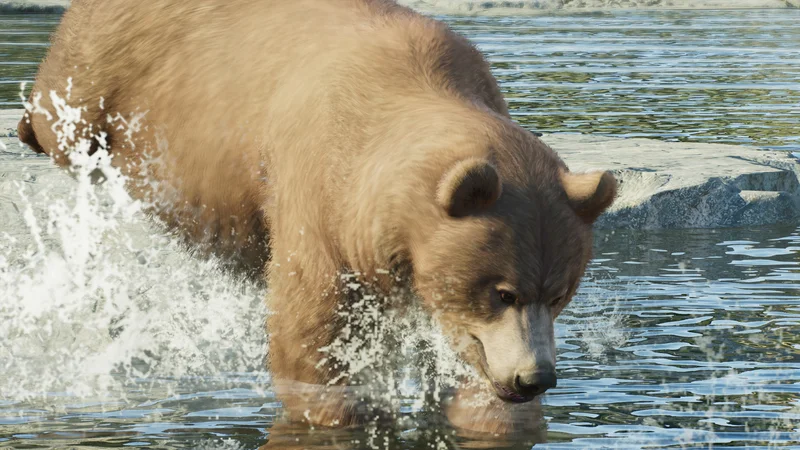
The official Zoopedia entry follows the same framing: the grizzly is explicitly “a subspecies of the brown bear,” identifiable by a thick brown coat, a large shoulder hump, a straight snout, rounded ears and long claws built for digging. Whether Frontier’s in-game stats for the grizzly differ from any separate Eurasian brown bear entry in finer details is something specific figures are still under community testing can settle; what is published today is the grizzly’s own habitat block, which this guide uses throughout.
Grizzly bear statistics and habitat requirements
Grizzlies vary enormously between populations, but the Zoopedia gives working averages: males reach 2.2 m in head-body length at around 240 kg, females 1.8 m at around 160 kg.
| Fact | Detail (official Zoopedia) |
|---|---|
| Scientific name | Ursus arctos horribilis |
| Conservation status | Least Concern (IUCN) |
| Native range | North America |
| Biomes | Taiga, Temperate, Tundra, Wetlands |
| Periodic food expense | $601.00 |
| Population range | 1–2 |
| Temperament | Confident |
Minimum habitat requirements are 970 m² of land, a 30 m² shelter and 30 m² of aquatic area — the water is not decorative, and bears will use it. The barrier must be Grade 4 strength (a step above the wolf’s Grade 3) though only 2 m high, which reflects power over jumping. Terrain tolerances are generous: grass and soil each 10–100%, rock 0–70%, sand 0–20% and snow 0–100%, across a temperature window of -15 °C to 28 °C. Like the wolf, the grizzly has no compatible species for thriving or neutral mixed habitats.
Feeding an omnivore: diet and food enrichment
The grizzly’s conservation topics list “Omnivore Diet” front and centre, and the enrichment roster is essentially a foraging toolkit: Block of Frozen Fish, Block of Frozen Fruit, Grazing Ball Feeder, Melon Feeder, Tree Scatter Feeder, Foraging Wall and the Frozen Blood Pumpkin, backed by habitat items like Herb Scent Marker, Rubbing Pillar, Ice block and Bobbin Drum.
The design lesson from the Zoopedia text is that wild grizzlies structure their social lives around food: the only time solitary bears tolerate close quarters is a concentrated food source, the salmon run being the classic example. Replicate that in the habitat. Scatter feed rather than bowl feed, freeze items to extend engagement, and rotate enrichment positions so the bear patrols its full territory. A grizzly that spends its day working for food is a grizzly exhibiting natural behaviour; one fed from a single station is an expensive lawn ornament. The habitat design guide has more on pacing feeding zones through an enclosure.
Hibernation and the winter season
The grizzly lifecycle is built around the den. Mating runs from May to June, after which the female undergoes delayed implantation: the embryo only begins developing once she enters the winter den, so cubs are born during hibernation after a listed gestation of about seven months. Litters run 1–4 cubs, which nurse through the rest of the winter and emerge with their mother for their first solid food.
For zoo management, this creates a yearly rhythm: a secure, enclosed den area with heavy snow cover nearby (snow tolerance reaches 100%), a temperature band that dips to -15 °C, and a female you leave undisturbed through the winter. Whether bears in-game fully shut down like their wild counterparts, or reduce activity while remaining visible, is a specific figure still under community testing — but the Zoopedia reproduction data (interbirth period of 52 months) tells you each litter is a multi-year investment, so protect it.
Solitary by design: social and breeding management
The Zoopedia is blunt: grizzlies are solitary except for mothers with cubs, interacting only to mate or to fight over mates and foraging grounds, with males aggressively driving off rivals. The group ranges reflect it — mixed groups of 1–2, and a maximum of one male and one female. Offspring dispersal is listed as “all offspring,” and cubs stay with their mother for 2–3 years before leaving to establish territory.
That gives you a clean management loop. Keep one adult male and one adult female, breed them, and plan a cub exit strategy years in advance: cubs must leave before the mother is ready to mate again, and she may skip seasons after dispersal. Reproduction difficulty is listed as easy, so the constraint is logistics, not biology. In sandbox mode you can keep a matriarch and her cubs together indefinitely for guests; in career or franchise play, respect the dispersal timer or accept the welfare cost.
Least Concern, still a conservation story
The Least Concern rating surprises many players, but the grizzly’s own Zoopedia page carries the counterweights: Genetic Bottlenecks, Population Fragmentation, Human-Wildlife Conflict and Ecological Restoration all appear as conservation topics. The species is secure in aggregate and locally embattled — the classic shape of a large carnivore sharing land with people. That makes the grizzly an excellent exhibit for teaching the difference between a global status and a regional reality, and its confident temperament means it tolerates busy guest areas better than shy species.
Budget around $601.00 per period in food, keep the enrichment rotating, and treat each litter as the centrepiece of a North American zone. For welfare thresholds across species, see the animal welfare guide; for where the grizzly sits among the full roster, check the all-animals list.
Related Articles
animals
Planet Zoo 2 African Leopard: The Most Adaptable Big Cat
Planet Zoo 2 African leopard guide: Zoopedia profile, tree-climbing habitat design for its caching instinct, and how it differs from lion and snow leopard.
animals
Planet Zoo 2 Lynx: Eurasian Lynx Habitat Design and Rewilding Guide
Planet Zoo 2 lynx guide: Eurasian lynx stealth hunting, vertical habitat design for a climbing cat, solitary care versus lions, and European rewilding.
animals
Planet Zoo 2 Wolf: Pack Hunting AI, Monogamous Pairs and Rewilding Guide
Planet Zoo 2 wolf guide to pack hunting AI, monogamous alpha pairs, Scottish Highlands rewilding, and the habitat, barrier and welfare needs of grey wolves.
Was this helpful?
Thanks for the feedback!