Planet Zoo 2 Wolf: Pack Hunting AI, Monogamous Pairs and Rewilding Guide
Planet Zoo 2 wolf guide to pack hunting AI, monogamous alpha pairs, Scottish Highlands rewilding, and the habitat, barrier and welfare needs of grey wolves.
Quick answer: The grey wolf in Planet Zoo 2 is a pack canid organised around a single monogamous alpha pair; its welfare rises or falls on social cohesion, not raw habitat size. Official Zoopedia data lists a confident, Least Concern predator that needs 1,162 m² of land, a Grade 3 barrier at least 3 m high, and a social group of 2–12 animals, with no compatible mixed-species neighbours. Confirmed for rewilding releases into the Scottish Highlands Wildlife Reserve, a stable breeding pack doubles as a long-term conservation asset.
Grey wolf at a glance: the official Zoopedia data
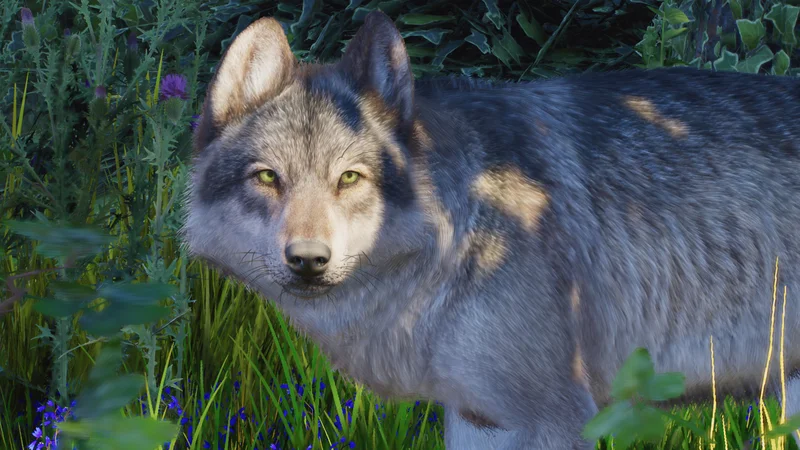
The official Zoopedia describes the grey wolf (Canis lupus) as a large generalist predator with 38 recognised subspecies spread across Europe, Asia and North America. Animals measure 105–160 cm plus a 29–50 cm tail, stand 80–85 cm at the shoulder, and weigh 43–45 kg (males) or 36–38.5 kg (females).
| Fact | Detail (official Zoopedia) |
|---|---|
| Scientific name | Canis lupus |
| Conservation status | Least Concern (IUCN) |
| Class / Family | Mammalia / Canidae |
| Native range | Europe, Asia, North America |
| Periodic food expense | $524.00 |
| Population range | 2–12 |
| Temperament | Confident |
| Mating system | Monogamous |
How does the pack hunting AI work in Planet Zoo 2?
Frontier has built the wolf around coordinated pack behaviour rather than lone-wolf wandering. In the Zoopedia social text, a typical pack contains one alpha male, one alpha female, their young adult offspring and a litter of pups under a year old. The pack is closely bonded: wolves become distressed when the group is split or when a member dies, which the welfare system reflects directly.
In practice, expect the habitat to function as a single moving unit. Hunts are initiated by the group and led by the alpha pair, subordinates flank and follow, and resting animals cluster within sight of each other. Exact chase success rates, coordination distances and hunt cooldowns are specific figures still under community testing, but the intent is clear: a wolf separated from its pack is a welfare problem, not a quirky individual.
Wolf packs vs African wild dog packs: the comparison
Because both species are pack canids, players routinely compare them. The African wild dog is the endurance specialist of open savannah; the grey wolf is the colder-climate family unit. The matrix uses official Zoopedia values for the wolf and published wild dog data.
| Trait | Grey wolf | African wild dog |
|---|---|---|
| Social unit | Family pack around one alpha pair | Packs of related males with joined females |
| Breeding | Alpha monogamous pair only; pair bonds for life | Alpha pair breeds; pack raises the litter |
| Population range | 2–12 | Up to roughly 20 |
| Temperament | Confident | Social, high-energy |
| Biomes | Desert, Tropical, Grassland, Taiga, Temperate, Tundra | Savannah |
| Rewilding reserve | Scottish Highlands | Great Rift Valley |
| Conservation status | Least Concern | Endangered |
The wild dog is the harder-hitting conservation story; the wolf is the more forgiving exhibit species that still rewards proper pack management.
One partner for life: the monogamous core family
The wolf mating system is listed as monogamous, and the Zoopedia lifecycle text is unusually specific: the alpha male and alpha female bond for life, and only they produce pups. After a pregnancy of about 2.5 months, the female gives birth to 5–7 pups in a secluded den and stays with them for three weeks, fed by the alpha male while other pack members are kept out. Pups begin on regurgitated solid food at 3–4 weeks, are fully weaned by 8 weeks, and join hunts at 4–6 months.
Young wolves stay in the natal pack for 10 months to 4 years before dispersing to find a partner and found a new territory. Never sell one half of the alpha pair, and treat any pack member’s death as a welfare event for the survivors, not a bookkeeping change.
Rewilding the Scottish Highlands with grey wolves
Grey wolves are confirmed for release into the Scottish Highlands Wildlife Reserve, the game’s flagship European rewilding landscape. A wolf habitat is not just an exhibit but a production line for wild releases: one stable alpha pair raising a litter a year maps onto real-world rewilding logic, where each released family anchors a new territory.
With Ecological Restoration, Habitat Loss and Human-Wildlife Conflict on its conservation topic list, the wolf pairs naturally with educational signage as the narrative centre of a European zone.
Habitat, barrier and terrain requirements
Official minimums are demanding but focused on land rather than complexity: 1,162 m² of land area plus a 10 m² shelter. The barrier must be Grade 3 strength and 3 m high — the height matters as much as the strength, because a confident canid tests fences. Terrain tolerances are wide (sand, grass, rock and soil each 10–50%, snow 0–100%), and the temperature window runs from -18 °C to 29 °C across six biomes, from desert to tundra.
Thriving and neutral relationship lists are both empty: no compatible species, so no mixed wolf habitat. Give the pack long sightlines, multiple resting clusters within visual contact, and a sheltered den area that the alpha female can seal off during the first three post-birth weeks. Our habitat design guide covers layout principles that suit a wide-ranging pack species.
Feeding, enrichment and welfare pitfalls
At $524.00 per period, wolves sit mid-range for a large carnivore, but the pack multiplier means costs scale with group size. The enrichment roster reads like a hunting curriculum: Bamboo Feeder, Rotation Line Feeder, Piñata Zebra and Piñata Pronghorn for extraction and chase behaviour, plus Frozen Blood Pumpkin, Dog Ball, Blood Scent Marker, Tug Rope, Chew Toy and Prey-scented sack for scent and play drive.
The three pitfalls that sink wolf welfare are all social. First, splitting the pack — every removal is felt by the survivors. Second, underfeeding the group: with 2–12 animals, place food at multiple points so subordinates are not bullied off meals. Third, ignoring deaths: wolves grieve, and the welfare system models it. For the full welfare framework behind these rules, see the animal welfare guide, and browse the complete species list to plan the rest of your zoo around the pack.
Related Articles
animals
Planet Zoo 2 Lynx: Eurasian Lynx Habitat Design and Rewilding Guide
Planet Zoo 2 lynx guide: Eurasian lynx stealth hunting, vertical habitat design for a climbing cat, solitary care versus lions, and European rewilding.
animals
Planet Zoo 2 Grizzly Bear: Brown Bear Subspecies, Diet and Hibernation Guide
Planet Zoo 2 grizzly bear guide: brown bear subspecies, omnivore feeding and food enrichment, hibernation and denning, habitat sizes and conservation.
animals
Planet Zoo 2 Snow Leopard: Ghost of the Mountains Guide
Planet Zoo 2 snow leopard guide: official Zoopedia stats, alpine habitat design with rock climbing, and the Vulnerable conservation story of the ghost cat.
Was this helpful?
Thanks for the feedback!