Planet Zoo 2 Lynx: Eurasian Lynx Habitat Design and Rewilding Guide
Planet Zoo 2 lynx guide: Eurasian lynx stealth hunting, vertical habitat design for a climbing cat, solitary care versus lions, and European rewilding.
Quick answer: The Eurasian lynx in Planet Zoo 2 is a shy, solitary medium-sized cat — the largest of the world’s four lynx species — listed as Least Concern. Its official habitat minimums are modest in footprint (615 m² of land, 10 m² shelter) but unusual in shape: it requires 20 m² of climbable area and a 3 m barrier despite only Grade 2 strength, because lynx are vertical animals. Managing one well means thinking like a forest keeper, not a savannah keeper.
Fast facts: the Eurasian lynx in numbers
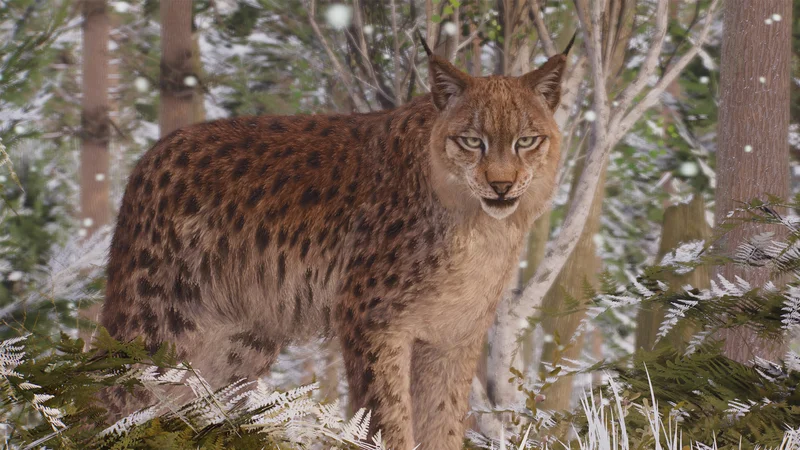
The Zoopedia describes the Eurasian lynx (Lynx lynx) as a stocky, broad-built cat of temperate and boreal forest and mountains across Europe and Asia, recognised by ear tufts, a stubby 11–24 cm tail with a black tip and a cream-to-tan spotted coat. Males weigh 20–45 kg and stand 60–75 cm at the shoulder; females are notably lighter at 18–25 kg.
| Fact | Detail (official Zoopedia) |
|---|---|
| Scientific name | Lynx lynx |
| Conservation status | Least Concern (IUCN) |
| Class / Family | Mammalia / Felidae |
| Native range | Europe and Asia |
| Biomes | Taiga, Temperate, Tundra |
| Periodic food expense | $602.00 |
| Population range | 1–3 |
| Temperament | Shy |
Wikipedia’s cross-check matches on status: Least Concern under IUCN 3.1, CITES Appendix II, with habitat loss, fragmentation and prey depletion as the standing pressures. The Zoopedia also notes the species is Romania’s national animal.
The ghost of the forest: how a stealth hunter behaves
Every part of the lynx’s published profile points the same direction — this is an invisible predator. Temperament is listed as Shy, its conservation topics include Nocturnal Behaviour and Food Scarcity, and one of its five official animal facts states that the Eurasian lynx is “an extremely quiet animal except during the mating season.” In winter it grows thick fur on its oversized feet, which Wikipedia describes as snowshoe-like, letting it move over snow at speed while prey sinks.
For exhibit planning, the behavioural read is simple: guests will not always see your lynx, and that is the point. Exact detection ranges, stalking and ambush triggers are specific figures still under community testing, but a shy crepuscular cat needs dense cover, elevated resting spots away from guest lines, and viewing areas that let patient visitors catch movement rather than a sleeping animal at ground level.
Designing vertical: climbing space and the habitat build
The lynx habitat block is the most vertical on the roster relative to its size. Minimums are 615 m² of land, 10 m² of shelter and — the headline figure — 20 m² of climbable area. The barrier is only Grade 2 strength, the same class as mid-sized stock, but it must be 3 m high. That combination tells you exactly what Frontier is modelling: lynx are not powerful fence-fighters, they are jumpers and climbers, and height is what contains them.
Terrain tolerances favour a forest floor: grass 30–80%, rock 20–60%, soil 0–40%, sand 0–20% and a little waterlogged ground up to 10%, across a generous -25 °C to 28 °C window. Build in layers — fallen logs, rock shelves, platform clusters connected by branches — so the 20 m² of climbable space is distributed rather than one lonely platform. There are no compatible species for mixed habitats, so the enclosure is a self-contained forest fragment. The habitat design guide covers the layering principles in detail.
A solitary cat is not a small lion
The most common lynx management mistake is importing big-cat assumptions. The lion is a pride animal whose welfare scales with social structure; the Sumatran tiger is solitary but a heavy, ground-oriented ambusher in dense tropical cover. The lynx is neither. Its Zoopedia group ranges are 1–3 mixed, one male and up to three females, with dominance listed as “none” — there is no pride hierarchy to manage and no alpha to keep happy.
In the wild, lynx live alone except for mothers with cubs, though the Zoopedia notes that males and females form strong bonds in captivity — so a bonded pair is a legitimate exhibit configuration, not a stress risk. Enrichment follows the feline baseline with a solitary twist: Scratching Post and Rubbing Pads for scent-marking behaviour, Prey-scented sacks to trigger stalking, and small balls and ice items for solo play. Because there is no pride to watch, guest appeal comes from behaviour — a lynx descending a rock face or working a scent trail beats any static display. The animal welfare guide explains how social needs differ across the cat roster.
Europe’s comeback cat: a rewilding success story
The Eurasian lynx is one of conservation’s quiet wins. Hunted out of most of Western Europe by the twentieth century, it has recolonised the Alps and the Carpathians and remains widespread in the north and east — a recovery strong enough that a national symbol (Romania) and a reintroduction debate (Scotland, where the Scottish Highlands Wildlife Reserve setting draws its real-world inspiration) both attach to the species. Its in-game conservation topics — Habitat Loss, Human-Wildlife Conflict, Ecological Restoration — mirror that trajectory: secure globally, contested locally.
That makes the lynx the perfect anchor for a European forest zone with an education focus. Pair the exhibit with signage on predator return and prey recovery, and it tells the same story the real species does: the forest is not complete until something is stalking through it.
Breeding lynx and raising cubs
Reproduction is listed as easy, with a defined rhythm. Mating runs in late winter, when calling and scent-marking spike — the one season the quiet cat gets loud. A male who finds a female follows her for 3–5 days of courtship before moving on, and may fight rivals who arrive at the same female. Gestation is 67–74 days, producing 1–4 cubs in a den of cave, hollow log or dense undergrowth, with an interbirth period of 21 months.
Cubs walk, eat solids and explore from 3–4 weeks, wean at 3–5 months, and stay with their mother until she is fertile again — anywhere from 1 to 3 years. Females mature at 21–27 months, males at 30–36. Plan a den corner with root tangles or a hollow-log structure, expect roughly one litter every two in-game years from a bonded pair, and check the all-animals list when slotting the lynx into a broader European collection.
Related Articles
animals
Planet Zoo 2 Wolf: Pack Hunting AI, Monogamous Pairs and Rewilding Guide
Planet Zoo 2 wolf guide to pack hunting AI, monogamous alpha pairs, Scottish Highlands rewilding, and the habitat, barrier and welfare needs of grey wolves.
animals
Planet Zoo 2 Grizzly Bear: Brown Bear Subspecies, Diet and Hibernation Guide
Planet Zoo 2 grizzly bear guide: brown bear subspecies, omnivore feeding and food enrichment, hibernation and denning, habitat sizes and conservation.
animals
Planet Zoo 2 Snow Leopard: Ghost of the Mountains Guide
Planet Zoo 2 snow leopard guide: official Zoopedia stats, alpine habitat design with rock climbing, and the Vulnerable conservation story of the ghost cat.
Was this helpful?
Thanks for the feedback!