Planet Zoo 2 Orangutan: Solitary Males, Vertical Habitats and the Sumatra Story
Planet Zoo 2 orangutan guide: Zoopedia stats, Critically Endangered status, solitary males, vertical habitat design and 104-month breeding.
Quick answer: The Sumatran orangutan is Planet Zoo 2’s Critically Endangered climbing specialist: a great ape with an estimated 14,000–15,000 individuals left in the wild, a planned population of just one to six, and one mature male allowed per habitat. You are building 780 m² of floor space plus 120 m² of climbable structure — the highest in the primate roster — behind a Grade 3 barrier 3 m high, at $1,248 per feeding cycle. Its 104-month interbirth period is the longest breeding cycle in the game.
The solitary ape you cannot keep alone
The orangutan is the only solitary great ape, and the Zoopedia is careful about what that means in a zoo. Wild individuals live alone except for a mother and her young, and they have far less social interaction than other apes — but they do not like complete isolation from their own kind. When they meet, they may be friendly, avoidant or aggressive, and occasionally a male and female travel together for a time. A single orangutan in an empty habitat is therefore a welfare mistake; a crowded one is worse. The intended setup is one flanged, dominant male presiding over a small territory with up to five females, which mirrors the polygynous mating system the Zoopedia documents.
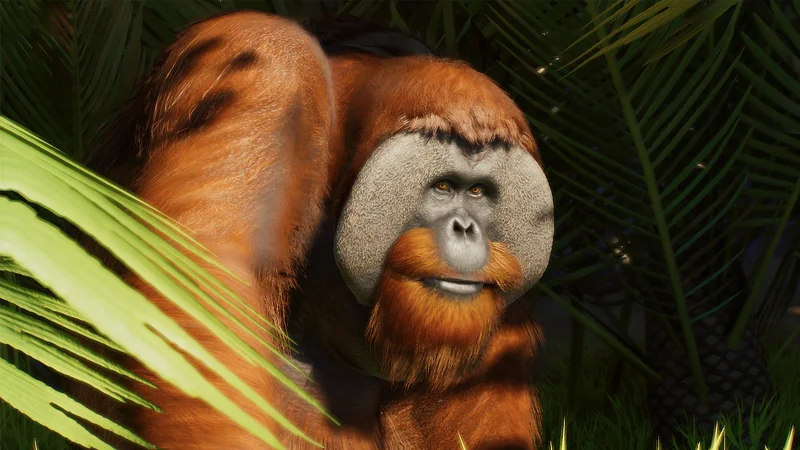
That male’s social signalling is the exhibit’s centrepiece. Mature dominant males develop cheek pads and a throat sac, and call across long distances to attract females into their territory. Younger, unflanged males exist in the wild as an alternative strategy, but the game simplifies: one male per enclosure. Male offspring disperse, so be ready to rehome sons as they mature.
Orangutan data from the Zoopedia
| Fact | Detail |
|---|---|
| Scientific name | Pongo abelii |
| Conservation status | Critically Endangered (IUCN) |
| Wild population | 14,000–15,000 (estimated) |
| Class / Order / Family | Mammalia / Primates / Hominidae |
| Temperament | Confident |
| Planned population | 1–6 (max 1 male, 5 females) |
| Barrier | Grade 3, 3 m high |
| Land / shelter / climbable | 780 m² / 15 m² / 120 m² |
| Food expense | $1,248 per cycle |
The neutral-relationship list is unusually long — siamang, Malayan tapir, Asian small-clawed otter, wild boar and several birds among them — so the orangutan accepts more company from other species than any other great ape, as long as its own sex ratio stays 1:5. That makes it the natural backbone of a mixed Southeast Asian rainforest build.
Build upward: the world’s largest tree-dweller
Orangutans are the largest arboreal animals on Earth — up to 1.8 m tall and 90 kg for a flanged male, seven times stronger than a human — and the habitat numbers reflect it. The 120 m² of climbable area is half again the chimpanzee’s 80 m² and triple the gorilla’s 40 m². Height is the design language here: canopy layers, rope bridges between mature trees, and feeding stations hung where the animal must genuinely climb, not just step, to reach them. Wild orangutans travel through the canopy, build fresh nests nightly and use tools with their mouths — a detail the Zoopedia flags as unique among apes, and one the tool puzzle feeder and termite mound enrichments clearly play to.
The enrichment roster mixes foraging and cognition: forage box, fruit spike tree, melon feeder, fixed roller feeder, termite mound and tool puzzle feeder for food, with mirror mobile, musical keyboard, curio ball and a rubber duck for play. Our habitat design guide has the full framework for stacking vertical space so guests can actually see a canopy-dwelling animal.
The 104-month equation
Here is the number that defines this species: a 104-month interbirth period — eight and a half years between births, the longest in Planet Zoo 2. Gestation runs about 8.5 months to a single infant, and the mother carries and teaches that infant for roughly eight years; young orangutans stay with their mothers until ten or eleven before dispersing to establish their own home ranges. Sexual maturity arrives around 10, the phases split into 10 juvenile, 31 adult and 17 elderly years, and the Zoopedia lists sterility simply as death — females remain fertile for life.
Do the arithmetic and a single female offers perhaps three to five offspring across an entire in-game career. There is no albino lottery to farm here — the only listed morph is albino, and chasing it at the cost of genetic health would be self-defeating. This is a species you keep because the exhibit and its story matter to you, not because it prints cash. Exact breeding-timing and release-reward figures are still under community testing.
Palm oil, deforestation and your Sumatra wing
The conservation text is direct: between 1985 and 2014, Sumatra’s rainforest cover fell dramatically, and large swathes are still cleared for oil-palm plantations, timber and agriculture. Fragmented forest prevents orangutans from finding food and mates; slow reproduction means even a few deaths or captures — for the pet trade, for meat, or as plantation pests — have outsized impact. Confiscated orangutans pass through rehabilitation centres before reintroduction, and the entry explicitly credits community-based conservation and shifting consumer demand away from palm oil as pressure points players can echo in signage and education.
That is why the orangutan pairs naturally with the Sumatra reserve and its rainforest-restoration narrative, and with the Sumatran tiger, which faces the same deforestation pressure. If you are building a Southeast Asian wing, one coherent story — vanishing forest, shared enemies, shared hope — runs through all of them. The wildlife reserves guide explains how release programmes turn a well-run habitat into measurable conservation output.
Why the orangutan anchors a themed zoo
Strip the systems away and the orangutan’s draw is spectacle: flame-orange fur, cheek pads, a long call guests can hear across the park, and a deliberate, unhurried climbing style that photographs beautifully. The conservation education topics the Zoopedia attaches — habitat loss, deforestation, poaching — write the interpretive signage for you. Few exhibits convert welfare investment into guest emotion this efficiently, and none carries a more urgent real-world headline. For the complete picture of where it fits among the other great apes, start from the all-animals page.
Related Articles
animals
Planet Zoo 2 Chimpanzee: Tool Use, Fission-Fusion Troops and Enrichment Guide
Planet Zoo 2 chimpanzee guide: Zoopedia stats, Critically Endangered status, fission-fusion troop management, tool enrichment and 52-month breeding.
animals
Planet Zoo 2 Gorilla: Silverback Family and Enrichment Guide
Planet Zoo 2 gorilla guide: official Zoopedia stats, Critically Endangered status, silverback group management, tool-based enrichment and slow breeding.
wildlife-reserves
Planet Zoo 2 Sumatra Reserve: Tropical Rainforest Restoration Guide
The Sumatra reserve in Planet Zoo 2 holds 15 releasable species, led by the Sumatran Tiger, Sumatran Orangutan, and Sunda Pangolin. Full list inside.
Was this helpful?
Thanks for the feedback!