Planet Zoo 2 Hammerhead Shark Guide: The Great Hammerhead's Sixth Sense
Planet Zoo 2 hammerhead shark guide: the Deluxe great hammerhead needs 960 m², Grade 3 barriers and a solitary life as a Critically Endangered giant.
Quick answer: The Planet Zoo 2 hammerhead shark — the great hammerhead (Sphyrna mokarran) — is a Deluxe-edition giant and the largest of all hammerheads, listed as Critically Endangered after losing more than 80% of its numbers in 70 years. The official Zoopedia demands 960 m² of deep saltwater at 20-28°C, Grade 3 barriers, a sandy bottom and a strictly solitary life of one or two sharks. At $1,064 per period it is a serious investment, but its albino morph and sixth-sense hunting make the Planet Zoo 2 hammerhead shark the crown exhibit of any aquarium wing.
What is the cephalofoil and how does a hammerhead hunt with it?
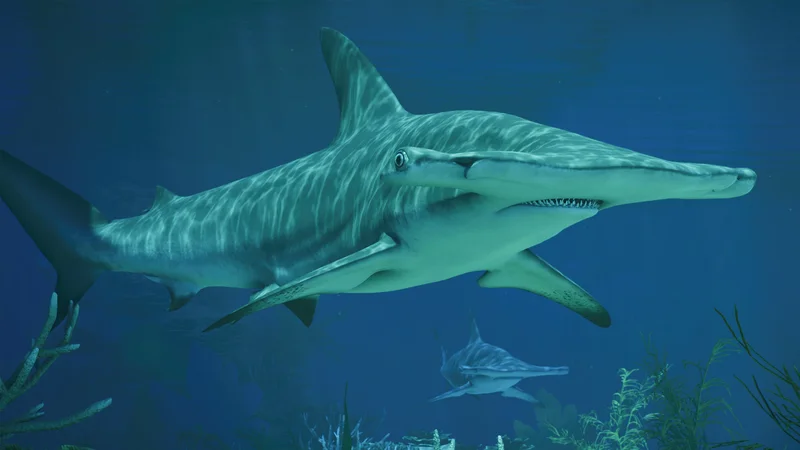
The hammer-shaped head has a formal name — the Zoopedia calls it a cephalofoil, from the Ancient Greek képhalos (head) and English “hydrofoil” — and it is a sensory organ as much as a profile. Its leading edge is packed with electroreception tissue, the ampullae of Lorenzini found in sharks and rays, which lets the shark detect the faint electrical fields of prey buried in sand. The fact sheet adds two behaviours worth building around: great hammerheads swim predominantly on their sides — “rolled swimming” — to improve their hydrodynamics, and they use the head itself as a weapon to bludgeon prey. Females are the giants of the species, exceeding 13.2 feet and reaching 19.8 feet, while males average around 9.9 feet; the Zoopedia records pregnant and very large females above 1,100 lb — a number worth repeating on your exhibit board, because guests remember it. When you theme a Planet Zoo 2 hammerhead shark tank, think open sand flats and low relief — hunting terrain, not coral maze. The Zoopedia’s rolled-swimming fact is your clue here: a shark that cruises tilted on its side wants unobstructed turning room, and Planet Zoo 2’s deep-water-area requirement is effectively the game asking for the same thing.
Why is the great hammerhead a Deluxe edition animal in Planet Zoo 2?
The official Zoopedia page flags the great hammerhead as a Deluxe-edition species, making it one of the headline additions for players with the upgraded edition of Planet Zoo 2. The price of entry matches the status in Planet Zoo 2: periodic food expense of $1,064 puts the shark in the game’s top spending tier, and the enrichment list is shark-specific — Suspended Bait for feeding, plus the Blood Scent Marker, Submarine Buoy, Bubble Blower airstone, Lattice Ball and Water Hoop for habitat work. The listed colour morph is albino, a rare white giant for dedicated breeding programmes. One more signature detail: the Zoopedia marks guests as able to walk through the exhibit, which in Planet Zoo 2 means the walkthrough aquarium experience — a tunnel or gallery where visitors pass beneath the shark — so budget guest-path space around the tank, not just in front of it. It is exactly the kind of showpiece Frontier reserves for its premium tier, and in Planet Zoo 2 the Deluxe roster is where the sequel’s most ambitious animals live.
What tank does a great hammerhead need in Planet Zoo 2?
The numbers are the biggest on the aquatic roster. Minimum habitat is 960 m² of deep water area — nearly twenty times a small reef fish tank — with barriers rated Grade 3 strength at 1 m height, the same barrier grade as big cats on land. Terrain calls for sand at 20-100% coverage, optional soil up to 100% and rock up to 20%, so a clean sandy arena with scattered rock is the intended look. Water is saltwater held at 20-28°C, the widest temperature band among the Planet Zoo 2 sharks. Population is one to two sharks, and the Zoopedia caps the group at one male and one female — this is a solitary animal where “some other species of hammerhead” school, this one does not. Water chemistry targets beyond temperature and salinity are still under community testing. Because the band runs a full 20-28°C, the great hammerhead tolerates cooler water than the reef species of Planet Zoo 2, which helps when you are plumbing one filtration loop through a whole aquarium wing. For the full aquarium construction system, see our aquatic animals guide and the habitat design guide.
Can great hammerheads live with other sharks?
Not in this game. The Zoopedia lists no thriving and no neutral relationships for the species, and its dominance note is blunt: larger sharks may attack, kill and eat smaller individuals. In Planet Zoo 2 that makes the great hammerhead a true solo exhibit — the one shark your aquarium wing builds an entire gallery around, rather than a member of a mixed predator tank. If you want multi-species shark action, the Indo-Pacific leopard shark thrives alongside eleven tank mates including rays and other sharks, and the blacktip reef shark fits themed reef-and-mangrove builds. Both are excellent Planet Zoo 2 exhibits in their own right — they just answer a different design question than the hammerhead does. Housing this species alone in Planet Zoo 2 is not a limitation; it is the species’ biology, and a single 19-foot silhouette crossing a sandy tank is more dramatic than any crowd.
How does a Critically Endangered giant reproduce?
The life history explains both the drama and the crisis. Mating occurs in warmer months, with pairs circling each other at the surface and males biting to hold position — a behaviour reflected in the Zoopedia’s reproduction notes. Gestation runs about eleven months, after which six to fifty live pups are born (twenty to forty being typical), each 20-28 inches long with rounded, flexible cephalofoils that straighten and harden with growth. Females breed only every two years, males mature at five to nine years and females around fifteen — a slow pipeline the game nonetheless rates as Easy for breeding, so Planet Zoo 2 players who want a breeding programme can run one without fighting the mechanics. Conservation is the dark mirror: upwards of 80% of great hammerheads lost in 70 years, driven by fin demand, with slow growth and biennial breeding leaving little capacity to recover. Release types for Planet Zoo 2 are solitary males and solitary females, sending one giant back at a time. It is slow conservation for a slow animal, and Planet Zoo 2 makes the wait part of the point — this is a species where every individual counts. Every launch species is catalogued in our all-animals list.
Related Articles
animals
Planet Zoo 2 Clown Anemonefish Guide: Anemone Symbiosis and Reef Tank Care
Planet Zoo 2 clownfish guide: pair them with a host sea anemone, keep 1 to 5 fish in 50 m² of saltwater at 24-28°C, and breed a dominant pair the easy way.
animals
Planet Zoo 2 Leopard Shark Guide: Deep Dives and Nocturnal Life
Planet Zoo 2 leopard shark guide: the zebra shark dives to 200 ft, rests by buccal pumping, lays huge eggs and needs just 36 m² and a Grade 2 barrier.
animals
Planet Zoo 2 Blue Tang Guide: The Real Fish Behind a Famous Cartoon
Planet Zoo 2 blue tang guide: the palette surgeonfish behind the famous cartoon fish needs 50 m² of saltwater at 23-28°C and breeds easily once settled.
Was this helpful?
Thanks for the feedback!