Planet Zoo 2 Leopard Shark Guide: Deep Dives and Nocturnal Life
Planet Zoo 2 leopard shark guide: the zebra shark dives to 200 ft, rests by buccal pumping, lays huge eggs and needs just 36 m² and a Grade 2 barrier.
Quick answer: The Planet Zoo 2 leopard shark — the Indo-Pacific leopard shark (Stegostoma tigrinum), also known as the zebra shark — is an Endangered, slow-cruising bottom shark and one of the friendliest builds in the game’s aquatics roster. The official Zoopedia asks for just 36 m² of deep saltwater at 24-29°C behind Grade 2, 1 m barriers, allows groups of up to twenty, and lists thriving relationships with eleven species including rays, turtles and other sharks. Add egg-laying reproduction and three colour morphs, and the Planet Zoo 2 leopard shark is the definitive community-tank shark.
Why is it called both a leopard shark and a zebra shark?
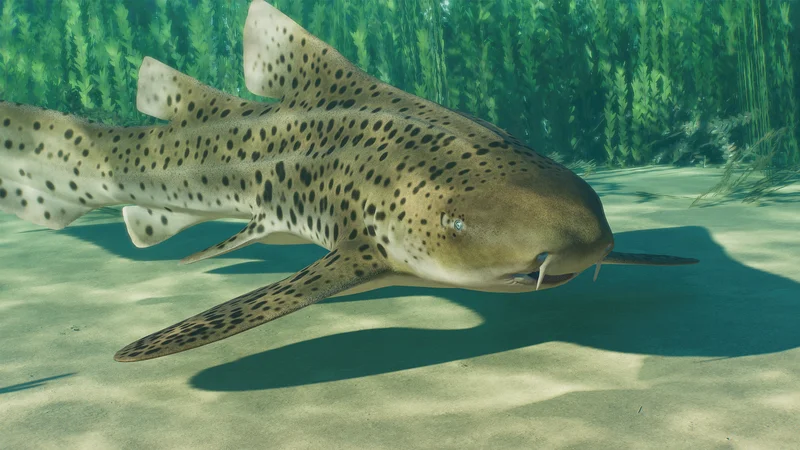
The two names describe two life stages. The Zoopedia explains that juveniles wear bold black-and-white bands — hence the old common name “zebra shark” — before maturing into a pale yellow or tan body covered in dark leopard-like spots. Adults measure 6.6 to 8.91 feet, females growing larger than males, at 66-110 lb. The species ranges across the tropical Indo-Pacific from the Red Sea and East Africa to Southeast Asia, northern Australia and southern Japan, patrolling coral reefs, sandy lagoons and seagrass beds. In Planet Zoo 2 that dual identity is a gift for exhibit storytelling: one tank can show both the striped juvenile story and the spotted adult, and the Zoopedia lists three colour morphs to breed for — albino, a darker variation and a lighter variation — which gives Planet Zoo 2 breeding programmes a visible jackpot.
How deep do Indo-Pacific leopard sharks dive?
Far deeper than their sleepy reputation suggests. The Zoopedia records the species from the surface down to about 198 feet — call it 200 feet of vertical range — across reef, lagoon, seagrass and open-sea habitats. Yet it cruises at barely one mile per hour, among the slowest sharks in the ocean, and unlike many sharks it does not need to swim to breathe: it can remain stationary for hours, pumping water over its gills by buccal pumping. The Zoopedia ties the shark’s conservation topics to nocturnal behaviour, which fits a species that rests by day and hunts hard-shelled prey — crabs, mollusks and crustaceans crushed by flattened teeth — at night, wriggling its long, flexible body into reef crevices after them. In Planet Zoo 2, theme the tank with caves, overhangs and dim corners, and let guests discover the shark resting motionless rather than swimming laps. Planet Zoo 2’s nocturnal-behaviour framing means the tank is a different exhibit at different times of day — quiet and statuesque by morning, prowling by dusk.
What tank does a leopard shark need in Planet Zoo 2?
The minimums are remarkably modest for a seven-foot shark: 36 m² of deep water area, saltwater at 24-29°C, and Grade 2 barriers at 1 m height. Terrain runs from sand at 20-100% to optional soil and rock up to 50% each, so a sandy lagoon floor with scattered reef rock suits the species perfectly. Temperament is Confident, periodic food expense is $448 — mid-tier, cheaper than the great predators — and enrichments include Suspended Bait plus the Submarine Buoy, Water Hoop, Bubble Blower airstone, Lattice Ball and Blood Scent Marker. The Zoopedia notes the sharks are usually solitary but may gather in large groups on occasion for reasons unknown, and the game happily supports a planned population of up to twenty, so Planet Zoo 2 players short on space can still run a group without building another wing. Water chemistry beyond temperature and salinity is still under community testing. Hold the 24-29°C band, stock the Suspended Bait feeder, scatter the buoy, hoop and bubble enrichments along the back wall, and Planet Zoo 2 rewards you with a shark that actively uses every corner of its tank. Construction guidance lives in our habitat design guide and aquatic animals guide.
Which tank mates thrive with a leopard shark?
Here the species is unique among Planet Zoo 2’s sharks: it has a thriving-relationship list of eleven species — dolphinfish, giant grouper, blackspotted puffer, Javanese cownose ray, ocellated eagle ray, blacktip reef shark, sand tiger shark, sailfin snapper, clown triggerfish, hawksbill turtle and humphead wrasse — with only the red lionfish and ocean sunfish downgraded to neutral. That makes the Planet Zoo 2 leopard shark the anchor of the game’s mixed predator-and-ray aquarium, the one exhibit where a shark, gliding rays and a sea turtle share water without incident. If you want a lone-wolf contrast for a second gallery, the great hammerhead takes no tank mates at all. For a land-water comparison in the same park, the common hippopotamus shows how Planet Zoo 2 splits the difference between aquatic and terrestrial keeping. Few exhibits in the game combine this much life in one view, and the thriving list is Planet Zoo 2 telling you exactly how to build it.
How does an egg-laying shark breed in Planet Zoo 2?
Most large sharks give birth to live young; this one lays eggs, and the Zoopedia describes one of the stranger breeding stories in Planet Zoo 2. Females store sperm for extended periods — long enough that isolated females in real aquariums have produced young with no male present — then lay eggs in pairs, each encased in a large, tough, fibrous capsule 6.8 to 8.8 inches long that anchors to the seafloor. Incubation runs four to six months depending on water temperature, after which fully formed pups hatch at 8-10 inches. The game’s statistics list litters of two to six with a six-month gestation-incubation period and a five-month interbirth period, reproduction rated Easy, maturity at six to eight years for males and eight to ten for females, and a lifespan of 25-30 years in captivity. Release group types in Planet Zoo 2 include mixed groups and solitary males or females. Conservation is the sober note: Endangered through overfishing for meat, fins and liver oil plus bycatch, with marine protected areas and public-aquarium breeding programmes — exactly what your zoo in Planet Zoo 2 is simulating — doing the recovery work one egg case at a time. Browse the all-animals list for the full launch roster.
Related Articles
animals
Planet Zoo 2 Clown Anemonefish Guide: Anemone Symbiosis and Reef Tank Care
Planet Zoo 2 clownfish guide: pair them with a host sea anemone, keep 1 to 5 fish in 50 m² of saltwater at 24-28°C, and breed a dominant pair the easy way.
animals
Planet Zoo 2 Hammerhead Shark Guide: The Great Hammerhead's Sixth Sense
Planet Zoo 2 hammerhead shark guide: the Deluxe great hammerhead needs 960 m², Grade 3 barriers and a solitary life as a Critically Endangered giant.
animals
Planet Zoo 2 Blue Tang Guide: The Real Fish Behind a Famous Cartoon
Planet Zoo 2 blue tang guide: the palette surgeonfish behind the famous cartoon fish needs 50 m² of saltwater at 23-28°C and breeds easily once settled.
Was this helpful?
Thanks for the feedback!