Planet Zoo 2 Yellow Tang Guide: The Classic Marine Aquarium Fish
Planet Zoo 2 yellow tang care: keep 1 to 4 in 50 m² of saltwater at 24-28°C, feed aquatic flakes, and learn why this surgeonfish ruled the aquarium trade.
Quick answer: The Planet Zoo 2 yellow tang (Zebrasoma flavescens) is a bright-yellow surgeonfish from the central and western Pacific, listed as Least Concern and historically famous as the single most traded marine aquarium fish on Earth. The official Zoopedia asks for 50 m² of deep saltwater at 24-28°C, a loose group of one to four fish, and an Aquatic Feeder stocked with flakes. Confident by temperament and cheap to run at $117 per period, the Planet Zoo 2 yellow tang is the first fish most players should stock when they open a tropical reef tank.
Why is the yellow tang called a classic saltwater aquarium fish?
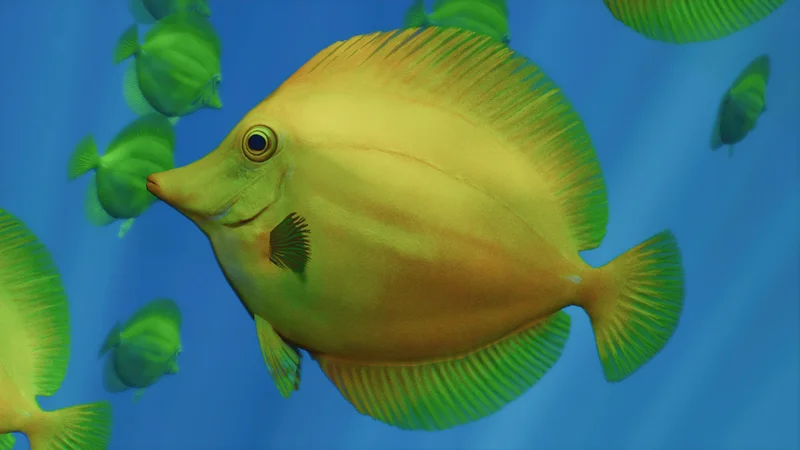
Few fish are as tied to the marine aquarium hobby as this one. The Zoopedia notes that yellow tangs historically made up as much as 80% of Hawaii’s aquarium fish exports — hundreds of thousands collected in peak years — which is why the species became the yellow fish every hobbyist pictures when someone says “saltwater tank.” Planet Zoo 2 leans into that legacy: a disc-shaped, canary-yellow fish with a laterally compressed body and a white defensive spine at the base of its tail, cruising a reef flat in loose company. Adults reach 12-20 cm and weigh 50-80 g, so a group reads as a school of living sunshine against the blue. In exhibit-design terms, the Planet Zoo 2 yellow tang is your reef tank’s default occupant — the species guests expect before they even know its name. In Planet Zoo 2’s aquatic showcases, it is small reef fish like this one that make an aquarium feel alive, and the yellow tang is their ringleader.
What makes yellow tangs surgeonfish?
The Zoopedia classifies the yellow tang in the surgeonfish family, Acanthuridae, and the name is literal: a sharp, retractable scalpel-like spine at the tail base that snaps out for defence. Three more facts round out the species’ identity. First, hatchlings are completely transparent and only develop their yellow later. Second, juveniles act as cleaner fish, picking dead skin and parasites off other reef fish — a behaviour you can theme into a mixed exhibit in Planet Zoo 2. Third, the fish changes colour at night, fading to a much paler yellow with a white stripe beneath the pectoral fins for camouflage, one of those small Planet Zoo 2 details worth a night-cycle camera — the game’s day-night lighting does the colour shift justice if you build dim viewing corners. Yellow tangs are herbivores, grazing turf algae across reef flats, lagoons and seaward reefs from Japan to the Marshall Islands. That grazing is the ecological job behind the Zoopedia’s herbivore-diet talk point: tangs crop the reef so coral can outcompete algae.
What habitat do yellow tangs need in Planet Zoo 2?
The official minimums mirror the other small reef fish of Planet Zoo 2: 50 m² of deep water area, saltwater at 24-28°C, and a planned population of one to four adults. Temperament is Confident, and the Zoopedia’s dominance note explains the behaviour you will see in the tank — dominant individuals occupy the prime feeding areas, so a group of four will visibly jostle over the best grazing ledges in Planet Zoo 2. Food-based enrichment is the Aquatic Feeder with flakes, and periodic food expense is $117. No barrier grade is listed, consistent with aquarium-style housing, and any water chemistry targets beyond temperature and salinity are still under community testing. Keep the tank inside the 24-28°C band, keep the flake feeder stocked, and Planet Zoo 2 will take care of the rest — this is one of the lowest-maintenance exhibits in the game. The build guidance in our habitat design guide applies to the viewing gallery around the glass just as much as to the water itself.
Who should share a tank with yellow tangs?
The Zoopedia records no thriving partners but twelve neutral species, a list that reads like a who’s-who of the Planet Zoo 2 reef roster: the clown anemonefish, palette surgeonfish, schooling bannerfish, threespot damselfish, blue and gold fusilier, Pacific sardine, Indo-Pacific sergeant and more. That neutrality is a design gift — you can stock a busy, layered reef wall and let the yellow tang anchor its upper water column. Keep smaller reef fish away from dedicated predator tanks, though: the blacktip reef shark herds fish exactly this size in the wild, so sharks and tangs belong in separate exhibits in Planet Zoo 2. For stocking logic across all aquatics, our aquatic animals guide lays out the full system. As a rule of thumb in Planet Zoo 2, anything on a small reef fish’s neutral list is fair game for a shared tank, and anything with teeth and a barrier grade needs its own building.
How do yellow tangs spawn and recover in the wild?
Breeding is rated Easy. Spawning peaks around the full moons of March and September, when males change colour and perform a shimmering dance to court females; pairs or groups then rush upward into the water column to release eggs and sperm together, a single female producing anywhere from 50 to more than 24,000 eggs depending on her size. The planktonic larvae may drift for 50 to 60 days before settling on a reef, juveniles shelter in coral crevices, and sexual maturity arrives between four and seven years old. In Planet Zoo 2 the breeding mechanics do not ask you to replicate the moonlight dance — a compatible mixed group in clean, warm water will spawn on its own. Wild populations are listed as unknown but abundant only in Hawaii, where marine protected areas restricting collection have measurably helped numbers — and where captive-bred tangs were released in one of the first stock-enhancement programmes ever attempted for a non-food marine species. It is a rare case where the aquarium trade’s favourite fish is also a conservation success story, and your yellow tang exhibit tells it beautifully. See the all-animals list for every species in the launch roster, and plan a second reef wing once your first tang group is settled — Planet Zoo 2’s aquatics reward players who expand early.
Related Articles
animals
Planet Zoo 2 Clown Anemonefish Guide: Anemone Symbiosis and Reef Tank Care
Planet Zoo 2 clownfish guide: pair them with a host sea anemone, keep 1 to 5 fish in 50 m² of saltwater at 24-28°C, and breed a dominant pair the easy way.
animals
Planet Zoo 2 Hammerhead Shark Guide: The Great Hammerhead's Sixth Sense
Planet Zoo 2 hammerhead shark guide: the Deluxe great hammerhead needs 960 m², Grade 3 barriers and a solitary life as a Critically Endangered giant.
animals
Planet Zoo 2 Leopard Shark Guide: Deep Dives and Nocturnal Life
Planet Zoo 2 leopard shark guide: the zebra shark dives to 200 ft, rests by buccal pumping, lays huge eggs and needs just 36 m² and a Grade 2 barrier.
Was this helpful?
Thanks for the feedback!