Planet Zoo 2 Blue Tang Guide: The Real Fish Behind a Famous Cartoon
Planet Zoo 2 blue tang guide: the palette surgeonfish behind the famous cartoon fish needs 50 m² of saltwater at 23-28°C and breeds easily once settled.
Quick answer: The Planet Zoo 2 blue tang is the palette surgeonfish (Paracanthurus hepatus) — royal blue, black-marked, yellow-tailed, and instantly recognisable as the species behind a certain famously forgetful cartoon fish. The official Zoopedia lists it as Least Concern, asks for 50 m² of deep saltwater at 23-28°C, and allows a planned group of one to five. Reproduction is rated Easy, food expense is $125 per period, and breeders can chase the regional Indian Ocean colour morph. For most zoos, the Planet Zoo 2 blue tang is the reef tank’s crowd-pleaser and its best film-tie-in story in one package.
Is the Planet Zoo 2 blue tang really the fish from the movies?
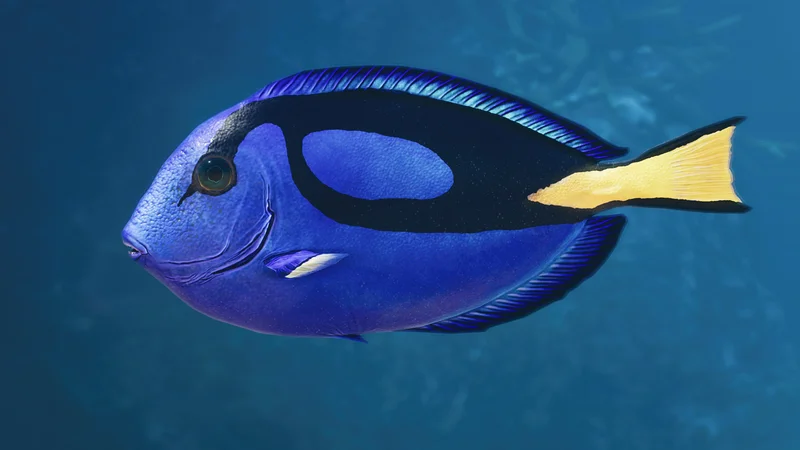
Yes — with a scientific footnote. The Zoopedia notes the palette surgeonfish is also commonly known as the blue tang or regal tang, and it is Paracanthurus hepatus that animators modelled the famous royal-blue character on. One detail the films skip: it is the only species in its entire genus, a one-of-a-kind lineage rather than one tang among many. Adults reach 10-12.4 inches and up to 1.32 lb, roaming Indo-Pacific coral reefs from East Africa and Japan down to Australia and the Great Barrier Reef at depths of roughly 6.6 to 132 feet. Planet Zoo 2’s render captures the field marks exactly — royal blue body, black markings, yellow tail — so guests who know the character will clock the species in seconds — and in Planet Zoo 2, the fish’s restless mid-water swimming sells the resemblance in motion, and the exhibit’s education talk points basically write themselves. Planet Zoo 2 players who grew up with the films get a quiet thrill from the reveal, and the genus fact — Paracanthurus has exactly one species — is the kind of detail that turns a pretty fish into a science lesson.
Why do palette surgeonfish carry a scalpel?
Like all surgeonfish, the palette surgeonfish keeps a pair of sharp, scalpel-like spines near the tail that deploy for defence — the anatomical detail behind the family name Acanthuridae. The Zoopedia describes the species as an omnivorous grazer, picking zooplankton and algae from reef systems, which fits its restless mid-water swimming style. Longevity is the surprise: the fact sheet credits the fish with up to 30 years in the wild, making it one of the longest-lived small reef fish you can keep in Planet Zoo 2. That lifespan matters for planning — a blue tang you buy for a starter reef may still be cruising the same tank in your zoo’s silver anniversary save file. Planet Zoo 2 leans on that realism: the Zoopedia lists the species at depths of 6.6 to 132 feet in the wild, so give your tank visual depth — a back wall that drops away, light filtering down from above — and the fish will use every metre of it.
What habitat does a blue tang need in Planet Zoo 2?
The official requirements sit in the same band as the other small reef fish of Planet Zoo 2: 50 m² of deep water area, saltwater held at 23-28°C, and a planned population of one to five adults. Temperament is Neutral and the dominance entry reads “None,” reflecting a fish that lives solitarily, in pairs, in small groups or larger loose aggregations depending on the reef and the food supply. The single listed food-based enrichment is the Aquatic Feeder with flakes, and periodic food expense is $125. No barrier grade is listed for the species, and any water chemistry targets beyond temperature and salinity remain under community testing until Frontier publishes official figures. Until then the temperature band is your main dial: hold 23-28°C, keep the flake feeder filled, and Planet Zoo 2 keeps a settled blue tang almost entirely hands-off. The colour morph — the Indian Ocean variant — gives breeding programmes something visual to chase, so check our aquatic animals guide before laying out a dedicated breeding tank.
Who should a blue tang live with in Planet Zoo 2?
The Zoopedia lists no thriving partners but twelve neutral species, including the clown anemonefish, the yellow tang, schooling bannerfish, longfin batfish and bluespine unicornfish. That is the same neutral web the other small reef fish share, so one well-stocked community tank can carry half the launch roster’s reef story at once: anemonefish hugging the bottom, yellow tang grazing above, and the blue tang patrolling open water. Keep the community away from dedicated predator exhibits — the blacktip reef shark is a separate, rated build — and use the habitat design guide to keep guest sightlines clear across the glass, and let Planet Zoo 2’s loose-aggregation behaviour fill the middle of the tank with constant, gentle motion.
How do blue tangs breed, and why was captive breeding so hard?
The wild breeding pattern is dramatic: broadcast spawning year-round with peaks between April and September, males courting females by circling, darting and nudging before pairs or small groups rush upward to release eggs and sperm at dusk or on lunar cues. A single female can release up to 40,000 buoyant eggs in one event; they hatch within 24 to 28 hours, and the planktonic larvae drift on currents before settling onto coral. The Zoopedia rates reproduction Easy in Planet Zoo 2, with maturity at nine to twelve months — one reason the fish makes a dependable breeding programme. Planet Zoo 2 does not ask you to stage the dusk spawning rush; a compatible group in the right water breeds on its own, and the Easy rating means patience is the only input. The conservation irony is that real-world captive breeding resisted science until the first success in 2016, so most trade specimens were still wild-caught, damaging both fish and coral habitat. Marine protected areas, reef restoration and responsible-sourcing campaigns are the counterweights, and the conservation-education framing in Planet Zoo 2 turns your tank into part of that awareness pipeline. Least Concern on the Red List but heavily collected, the palette surgeonfish is a case where your Planet Zoo 2 exhibit genuinely teaches something. Every launch species is catalogued in our all-animals list.
Related Articles
animals
Planet Zoo 2 Clown Anemonefish Guide: Anemone Symbiosis and Reef Tank Care
Planet Zoo 2 clownfish guide: pair them with a host sea anemone, keep 1 to 5 fish in 50 m² of saltwater at 24-28°C, and breed a dominant pair the easy way.
animals
Planet Zoo 2 Hammerhead Shark Guide: The Great Hammerhead's Sixth Sense
Planet Zoo 2 hammerhead shark guide: the Deluxe great hammerhead needs 960 m², Grade 3 barriers and a solitary life as a Critically Endangered giant.
animals
Planet Zoo 2 Leopard Shark Guide: Deep Dives and Nocturnal Life
Planet Zoo 2 leopard shark guide: the zebra shark dives to 200 ft, rests by buccal pumping, lays huge eggs and needs just 36 m² and a Grade 2 barrier.
Was this helpful?
Thanks for the feedback!